Author Archives: ayana2015

HM Government January 2017 Borrowing

Another month, guess what, take a lucky guess, it is the same old story, HM Government, spends more money than it receives via taxes and duties. Another deficit month, thus to bridge the gap, needs to borrow on the bond market.

In January 2017, the HM Government had to borrow money to meet the difference between tax revenues and public sector expenditure. The term for this is The PSNCR: The Public Sector Net Cash Requirement.

There were “only” 5 auctions of Gilts (UK Government Bonds) by the UK Debt Management Office (http://www.dmo.gov.uk/) to raise cash for HM Treasury:-

31-Jan-2017 1½% Treasury Gilt 2026 £2,444.0460 Million
18-Jan-2017 0½% Treasury Gilt 2022 £2,881.9490 Million
12-Jan-2017 2% Treasury Gilt 2025 £2,250.0000 Million
10-Jan-2017 0 1/8% Index-linked Treasury Gilt 2046 £837.7980 Million
05-Jan-2017 1¾% Treasury Gilt 2037 £2,329.9140 Million

When you add the cash raised:-

∑(£2,444.0460 Million + £2,881.9490 Million + £2,250.0000 Million + £837.7980 Million + £2,329.9140 Million =  £10,743.707  Million

£10,743.707  Million = £10.743707 Billion

On another way of looking at it, is in the 31 days in January, HM Government borrowed:-

£346 million each day for the 31 days.

We are fortunate, while the global banking and financial markets still has the confidence in HM Government to buy the Gilts (Lend money to the UK), the budget deficit keeps rising. What is also alarming, is the dates these bond mature 2022, 2025, 2026 and 2037. All long term borrowings, we are mortgaging our futures, but at least “We are in it together…

BT February 2017 Dividend.

The world’s most dynamic media and communications company is BT PLC

http://www.bt.com

Yesterday, BT paid its Feb 2017 dividend to its shareholders.

http://www.btplc.com/Sharesandperformance/Dividends/Dividends.htm

£0.0485 per share.

Now much did that cost BT plc ?

http://hsprod.investis.com/servlet/HsPublic?context=ir.access&ir_option=RNS_NEWS&item=2709228863094784&ir_client_id=1281

The total number of voting rights in BT Group plc on that date was 9,958,766,455

Thus:

9,958,766,455 x £0.0485 = £483,000,173.1

That is £483 MILLION.

http://www.shareshop.hsbc.co.uk/shareshop/security.cgi?csi=10025&action=

A yield of over 3%

London House Prices

Anybody who has lived or watched the prices of London homes for the past 20 years will tell you how much the city has changed. They could be talking about particular areas that were once considered undesirable, and are now flourishing, or they could be referring to the wealth of new businesses that have cropped up.
For example, areas like West Drayton are in the process of gentrification as Cross Rail arrives in 2017/18
In years gone by with the London 2012 Olympics, one has seen Stratford transformed.

I will now analyse average housing prices, salaries and the switch from buying to renting homes that many have chosen (or, perhaps more accurately, been forced into).

Housing Prices

Property prices in the UK have been growing in a pretty consistent manner over the years, and that rings true particularly in the nation’s capital.
The average price of a property in London, as of December 2016, is £487,649 (according to the Land Registry). This is 123 percent higher than the UK average (£217,888). London is known for being an expensive place to live. It’s always been that way. But younger individuals might be shocked to see how inexpensive, by today’s standards, the housing market was in 1996. Back then, the average price of a home was £79,000.

(In 1997 one could buy a detached house in the IP5 (Martlesham Heath in leafy Suffolk for £55,000)

As you can see, the rise in prices has grown consistently at a steep rate. Only following the 2008 recession did things get a little difficult, but now, they’re back on track. At the moment, the market is currently experiencing its steepest climb yet. It remains to be seen how things will work out in the future, but they look pretty strong right now.

Salary Growth, or Lack of first time buyers

The average first-time buyer in 1996 earned approximately £21,575 per year.

They borrowed, on average, around £55,575 from a mortgage lender in order to purchase their first home. Today, it is a very different story. Housing prices have increased, as we have seen, but salary raises haven’t been able to keep up. In 2016, a first-time-buyer typically needs to put down a deposit of £96,000 – and the average salary is only £51,000. That deposit figure is ten times what it was in 1996, while buyers today borrow an average of £174,000. So, obviously, it is now much more difficult to become a homeowner. And these figures are based on those who did manage to get a mortgage. I don’t know the number of people who would have been able to purchase a home, if salaries had risen at the same rate as housing prices. One of the reasons housing prices have risen so fast is because of a lack of supply. Therefore, it is incredibly important that new-build projects receive significant investment. There are sure to be a few people priced out of property, who instead are renting a place to live. Which leads onto our next point as to how the property market has changed.

Buying vs Renting

In 2001, approximately 15 percent of people who were living in London did not own their property. Instead, they were renting. Today, however, that figure has shot up to around 33 percent. It is difficult to argue that this is because of anything other than housing prices being too high for many people. Although there may be a few exceptions. Some people don’t like to be tied down, for example. But this has proven to be good news for the buy-to-let marketplace. There is a constant need for rental properties, and many investors have found success in this area. And according to research conducted by PwC, things are only going to get better for these individuals. By 2025, around 60 percent of Londoners will be renting.

Vodafone Feb 2017 Dividend.

Vodafone PLC pays out a dividend of €0.0474 today.

www.vodafone.com

The UK’s No 2 telecoms operator, behind the market leader and world beating BT Group PLC

The total number of voting rights in Vodafone is 26,617,945,523.

http://otp.investis.com/clients/uk/vodafone3/rns/regulatory-story.aspx?cid=221&newsid=832585

So the cash paid out to shareholders is:

26,617,945,523 x €0.0474 = €1,261,690,617.79

€1,261,690,617 = £1,110,590,000

Vodafone pays out £1.110 Billion.

http://www.shareshop.hsbc.co.uk/shareshop/security.cgi?csi=10097

A yield of 5%

The New River Real Estate Investment Trust.

The New River Real Estate Investment Trust is a near £800m London Listed investment trust investing in property.

http://www.nrr.co.uk/

The portfolio is:-

£1.3 billion  Assets Under Management  
96 % Occupancy 
33 Shopping Centres 
22 Retail Warehouses 
15 High Street Assets 
358 Pubs

http://www.shareshop.hsbc.co.uk/shareshop/security.cgi?csi=2057097&action=

Borrowings of £470.8m

The Debt of Marks and Spencer

The Debt of Marks and Spencer

Marks and Spencer PLC, the famous UK retailer, has a debt programme to fund its business operations.

http://corporate.marksandspencer.com/investors/debt-investors#edbb67e737a24f9d86ad48628067e7e5

April 2021  Syndicated revolving credit facility  £1.1bn
2017  US$500m  6.250% Semi-annually
2019  £400m  6.125% Annually
2021  £300m  6.125% Annually
2037  US$300m  7.125% Semi-annually
2025 £400m  4.750% Annually

That equates to:-

£1,100m + US$500m + £400m + £300m + US$300m + £400m =

£1100m + £405m + £400m + £300m + £243m + £400m = £2,848m

that is £2.848 Billion

Risk and Reward (Trackers vs Individual Stocks)

The picture below shows the dangers of a concentration of risk in one asset.

BTandFTSE

In the past days the FTSE has moved little, with highs of over 7,200 to lows of 7135. That is about a movement of 1%

BT plc has traded this week from £3.80 to as low as £2.99. That is price movement of 20%

The benefits of a fund like a FTSE-100 tracker is obvious. Never have all your eggs in one basket.

M&G High Income Investment Trust P.L.C.

The M&G High Income Investment Trust is an London Listed Investment Trust. The Company was incorporated on 23 December 1996 and is a split capital investment trust company with three share classes (Zero Dividend Preference Shares, Income Shares and Capital Shares).

http://www.shareshop.hsbc.co.uk/shareshop/security.cgi?username=&ac=&csi=12782&record_search=1&search_phrase=M&G High Income Investment Trust

http://www.shareshop.hsbc.co.uk/shareshop/security.cgi?username=&ac=&csi=12781&record_search=1&search_phrase=M&G High Income Investment Trust

http://www.shareshop.hsbc.co.uk/shareshop/security.cgi?username=&ac=&csi=12785&record_search=1&search_phrase=M&G High Income Investment Trust

It’s top twenty holdings are:

Treasury 1.00% 2017  8.90% ‘AAA’ credit rated bonds
Treasury 1.25% IL 2017  8.69% ‘AAA’ credit rated bonds
Royal Dutch Shell ‘B’ 4.30% Oil & gas producers
British American Tobacco 4.16% Tobacco
AstraZeneca  3.61% Pharmaceuticals & biotechnology
GlaxoSmithKline 3.45% Pharmaceuticals & biotechnology
HSBC Holdings 3.00% Banks
Vodafone Group 2.70% Mobile telecommunications
BP 2.56% Oil & gas producers
Sage Group 2.19% Software & computer services
Unilever 2.07% Food producers
Imperial Tobacco 2.02% Tobacco
Aviva 1.91% Life insurance
BT Group 1.80% Fixed line telecommunications
RELX 1.79% Media
National Grid 1.62% Gas, water & multi-utilities
United Utilities  1.62% Gas, water & multi-utilities
Legal & General Group 1.57% Life insurance
Essentra 1.49% Support services
Rio Tinto 1.34% Mining

Twenty largest holdings 60.79% = £254million

http://docs.mandg.com/AR/MandG-High-Income-Investment-Trust_Annual-Report-and-Accounts_GB_ENG.pdf

Norges Bank Investment Management: External Fund Managers

One of the largest money managers in the world is Norges Bank. It is the Central Bank of Norway, and manages the profits from its oil industry.

www.nbin.no

Over 7,500 BILLION Krona = £700 Billion = €833 Billion = $869 Billion.

It manages the money with investments in Shares, Fixed Income (bonds) and Real Estate.

It also has manadates with external fund managers:-

External Equity Fund Managers

◾3G Radar
◾A/T Capital Management
◾Abax Investments
◾Ajeej Capital
◾Altus TFI
◾AM Advisors
◾Andino
◾Ashmore Equities Investment Management
◾B & P Asset Management
◾ATR Kim Eng Capital Partners
◾Avaron Asset Management
◾BlackRock
◾BPH TFI
◾Capital International Limited
◾Cephei Capital Management
◾CIM Investment Management
◾Concorde Asset Management
◾DNB Asset Management
◾Dragon Capital Management
◾Duet Mena
◾Eastspring Investments
◾Ecofin
◾Ellerston Capital
◾ENAM Asset Management
◾Fairtree Capital
◾Financiere Arbevel
◾Foord Asset Management
◾FPM Frankfurt Performance Management
◾GCA Investment Management
◾Gondo Visio and Visio Capital Management
◾Greenwoods Asset Management
◾Investec Asset Management
◾Ion Value Management
◾Kairos Partners
◾Karma Capital Advisors
◾Keel Capital
◾Keywise Capital Management
◾Krungsri Asset Management
◾Laurium Capital
◾Lazard Asset Management
◾Levin Capital Strategies
◾Lynear Wealth Management
◾Maybank Asset Management
◾Meritz Asset Management
◾Mirabaud Asset Management
◾Moneda Asset Management
◾Nabo Capital
◾Neuberger Berman Asia
◾Obafrica AM and La Financiere de l’Echiquier
◾Old Mutual Global Investors
◾Operadora GBM
◾Pacific Alternative Asset Management Company
◾Prosperity Capital Management
◾Quantum Advisors Private Limited
◾Rasmala Asset Management
◾Red Gate Asset Management
◾Rheos Capital Works
◾Schroder Investment Management
◾Sparx Asset Management
◾Specialised Research
◾Springs Capital
◾Squadra Investments
◾Steyn Capital Management
◾Templeton Asset Management
◾Temporis Capital
◾Verno Capital
◾Victoire Brasil Investimentos
◾VIP Research & Management
◾Visio Capital Management
◾Water Asset Management
External Fixed-Income Managers

◾Ashmore Equities Investment Management
◾Investec Asset Management
◾Templeton Asset Management

Financial Implications of Brexit: Banking Jobs Leaving the UK

The loss of well paid banking jobs due to Brexit can not be under estimated.

http://www.bbc.co.uk/news/business-38677504

So HSBC and UBS are saying 2,000 investment banking jobs are going to be out transferred of London.
What does this mean financially ?

So lets make some rough calculations:-

HSBC: 1,000 jobs to leave London.
If the average wage of an investment banker at HSBC is £115,000 then the wage bill that leaves London is:
1,000 * £115,000 = £115,000,000 (£115 Million)

UBS:  1,000 jobs to leave London.
If the average wage of an investment banker at UBS is £125,000 then the wage bill that leaves London is:
1,000 * £125,000 = £125,000,000 (£125 Million)

The taxs that will be lost by the UK Goverment:-

HSBC: Wage bill of £115,000,000 and assume 45% goes in total due to income tax and national insurance.
That is £51,750,000 (£51.75 Million)

UBS: Wage bill of £125,000,000 and assume 45% goes in total due to income tax and national insurance.
That is £51,750,000 (£56.250 Million)

A total loss of £108,000,000 (£108m). That is £108m less for HM Government to spend on UK defence, public services like hospitals, schools, universities or police.

Now what else you have to remember, is the salaries after tax, are known as disposable income.

HSBC wage bill of £115 Million, 45% lost in tax (£51.75 Million) leaving £63,250,000) to be spend by employees.
That money is for travel, paying for London Transport, on Oyster or Taxi / Uber. Eating in restaurants, or cinema or buying food at Tesco.
All money that is now lost.

UBS wage bill of £125 Million, 45% lost in tax (£56.250 Million) leaving £68.750) to be spend by employees.
That money is for travel, paying for London Transport, on Oyster or Taxi / Uber. Eating in restaurants, or cinema or buying food at Tesco.
All money that is now lost.

That money supports local jobs, cinema workers, supermarket workers, taxi drivers.

Also those 2,000 people are not paying council tax.

Average Council tax of say £1,100 a year.
2,000 * £1,100 = £2,200,000.00 (£2.2 million) less for councils which means less cash for social care, libraries, refuse/trash collection, street cleaning.

Brexit. Loss of cash for the UK. Serious indeed, and www.asadkarim.co.uk calculations are just on 2,000 jobs.

The Sanditon Investment Trust PLC

The Sanditon Investment Trust plc in a London listed investment company. It invests predominantly in listed equity securities of companies

• which derive a significant proportion of their revenues or profits from; or
• which are predominantly operating in the EU, the EEA or Switzerland.

Top 10 Long Positions:-

Babcock International 6.9%
RELX 5.1%
Melrose Industries 4.3%
Diageo 3.1%
Man Group 2.9%
Laird 2.8%
ITV 2.7%
Sanditon Asset Management 2.6%
BHP Billiton 2.4%
HSBC 2.2%

Total 35.0

http://www.shareshop.hsbc.co.uk/shareshop/security.cgi?username=&ac=&csi=32719505&record_search=1&search_phrase=sit

GlaxoSmithKline January Dividend.

Last week on Thursday 12th Jan, GlaxoSmithKline paid its dividend to its shareholders.

http://www.gsk.com

It was 19p a share.

The total number of voting rights in the Company is 4,910,110,112

http://www.londonstockexchange.com/exchange/news/market-news/market-news-detail/GSK/13083316.html

So the cost of the dividend to GSK was:

4,910,110,112 * £0.19 = £932,920,921.28

That is £932 Million of Cash.

http://www.shareshop.hsbc.co.uk/shareshop/security.cgi?csi=10042

That is a 5% yield.

Aberdeen Frontier Markets Investment Company

The Aberdeen Frontier Markets Investment Company is a £100m investment company, whose objective is to provide shareholders with long term capital growth by investing in the Frontier
Markets of Africa, the Middle East, Eastern Europe, Asia and Latin America.

It’s top ten holdings that make up 65% of the fund are:

Advance Copernico Argentina Fund Argentina 8.6%
East Capital Balkan Fund – C Class Balkans 8.3%
Fondul Proprietatea GDR Romania 8.1%
Tundra Pakistan Fund Pakistan 7.6%
VinaCapital Vietnam Opp. Vietnam 7.0%
PXP Vietnam Emerging Equity Fund Vietnam 6.8%
Sturgeon Central Asia Equities Fund Asia 6.0%
SCM Africa Fund Africa 4.9%
SC Africa Consumer Fund Africa 4.2%
MSCI Pakistan Pakistan 3.9%

Total 65.6%

http://www.shareshop.hsbc.co.uk/shareshop/security.cgi?csi=232655

A yield of 1.5%

Marks and Spencer January 2017 Dividend.

The most famous shop on the UK high street is the highly regarded Marks and Spencer

http://www.marksandspencer.com

Today, Friday 13th Jan 2017 Marks and Spencer pays it dividend.

It is 6.8p a share.

How much will this cost Marks and Spencer PLC today ?

http://otp.investis.com/generic/regulatory-story.aspx?newsid=832422&cid=228

The Company’s capital consists of 1,624,726,830 ordinary shares with voting rights

So 1,624,726,830 x £0.068 = £110,481,424.44

£110m leaves the bank account today.

HM Government December 2016 Borrowings

Another month, guess what, take a lucky guess, it is the same old story, HM Government, spends more money than it receives via taxes and duties. Another deficit month, thus to bridge the gap, needs to borrow on the bond market.

In December 2016, the HM Government had to borrow money to meet the difference between tax revenues and public sector expenditure. The term for this is The PSNCR: The Public Sector Net Cash Requirement.

There were “only” 4 auctions of Gilts (UK Government Bonds) by the UK Debt Management Office (http://www.dmo.gov.uk/) to raise cash for HM Treasury:-

14-Dec-2016 0 1/8% Index-linked Treasury Gilt 2036 £800.0000 Million
07-Dec-2016 1½% Treasury Gilt 2047 £2,250.0000 Million
06-Dec-2016 1½% Treasury Gilt 2026 £2,668.5700 Million
01-Dec-2016 0½% Treasury Gilt 2022 £3,122.8290 Million

[http://www.dmo.gov.uk/reportView.aspx?rptCode=D2.1prof7&rptName=47806644&reportpage=Summary_of_results]

When you add the cash raised:-

∑(£800.0000 Million + £2,250.0000 Million + £2,668.5700 Million + £3,122.8290 Million =  £8,841.399 Million

£8,841.399 Million = £8.841399 Billion

On another way of looking at it, is in the 31 days in December, HM Government borrowed:-

£285million each day for the 31 days.

We are fortunate, while the global banking and financial markets still has the confidence in HM Government to buy the Gilts (Lend money to the UK), the budget deficit keeps rising. What is also alarming, is the dates these bond mature 2022, 2026, 2036 and 2047. All long term borrowings, we are mortgaging our futures, but at least “We are in it together…”


The Debt of Costa Coffee.

The UK High Street is dominated by Costa Coffee on every shopping street.

Costa Coffee is owned by the Whitbread group

https://www.whitbread.co.uk/

To fund operations, apart from the cash generated by the business, Whitbread has a bond issuance programme.

https://www.whitbread.co.uk/investors/key-financial-information/corporate-debt.html

When you add the debt securities issued it comes to £1,706.90 Million.

That is £1.7bn of debt.

Lets keep things in context, its sales are in 15.16 were £2,921.8m.

Rolls Royce PLC: January Dividend.

Yesterday, 6th Jan, Rolls Royce PLC, one of the most highly regarded engineering companies in the world, paid its dividend to its shareholders.

http://www.rollsroyce.com

It was 4.6p per share.

http://www.shareshop.hsbc.co.uk/shareshop/security.cgi?username=&ac=&csi=10072&record_search=1&search_phrase=rr

How cash did the dividend cost Rolls Royce PLC ?

The issued share capital of the Company is comprised off 1,838,787,676 ordinary shares of 20p each with voting rights.

http://otp.investis.com/clients/uk/rolls-royce1/rns/regulatory-story.aspx?cid=171&newsid=822957

Thus

1,838,787,676 x £0.046 = £84,584,233.10

£84m in cash.

Now Blackrock own 5% of Rolls Royce:

http://otp.investis.com/clients/uk/rolls-royce1/rns/regulatory-story.aspx?cid=171&newsid=820016

they have 92,012,850 shares, so they got 92,012,850 * £0.046 = £4,232,591.10 in cash, that is £4.2m

The realities of the Uber economy.

Picture the situation in London. Rent is £1000 a month for a small flat. The tenant is a driver for Uber. Now this person works all day as a self employed driver. They earn about £9 a hour.

One then  has to look at the real picture. So they have to run the car, fuel it, pay for wear and tear on the car, such a tyres.

Then they need to pay themselves a wage. The income is based on picking up passengers. It is not constant.

Wages are low. Tax collected then by the government is low. National Insurance collected by the government is low.

Rent paid by the driver is high, at £1000 a month. The numbers do not work.

Living standards are falling. Taxes collected by government to pay for key public services are falling. People are just making a living.

TR Property Investment Trust

Today, the TR Property Investment Trust, a London listed FTSE-250 Real Estate investment fund paid out a dividend of 4.1p per share.

http://www.trproperty.com/

It invests in Pan European equities and UK direct property on behalf of its shareholders.

It’s top ten indirect holdings are:-

Top Ten Holdings

UNIBAIL-RODAMCO 10.4%
LAND SECURITIES GROUP PLC 7.6%
VONOVIA SE 7.0%
LEG IMMOBILIEN AG 6.2%
KLEPIERRE 5.4%
FONCIERE DES REGIONS 3.1%
BUWOG AG 2.7%
DEUTSCHE WOHNEN AG 2.6%
SEGRO PLC 2.5%
HISPANIA ACTIVOS INMOBILIARIOS SAU 2.5%

It then holds direct properties in its portfolio which accounts for just over 8% of its total holdings:

Strategic allocation (%)

UK Shares 32.3
UK Direct Property 8.8
Continental Shares 71.2
Debt -12.3

TOTAL 100.0 %

http://www.shareshop.hsbc.co.uk/shareshop/security.cgi?username=&ac=&csi=13847&record_search=1&search_phrase=TRY

HICL December Dividend.

Tomorrow, HICL Infrastructure pays out £0.0191 on Dec 30th 2016.

https://otp.tools.investis.com/clients/uk/hicl/rns/regulatory-story.aspx?cid=1239&newsid=816302

HICL is now a member of the FTSE-250, it began life known as HSBC Infrastructure.

http://www.hicl.com

The Company’s issued share capital consists of 1,457,706,805 ordinary shares

https://otp.tools.investis.com/clients/uk/hicl/rns/regulatory-story.aspx?cid=1239&newsid=801023

That means the total cost of the dividend to HICL was:-
1,457,706,805 ordinary shares  x £0.0191 = £27,842,199.98
That is £27.84 Million.

http://www.shareshop.hsbc.co.uk/shareshop/security.cgi?csi=185903&action=

A yield of 4.5%

The Unaffordable Cost of Private Education

School fees for public schools in the UK have no connection to the salaries of the middle classes.

1. Eton College
http://www.etoncollege.com/currentfees.aspx

£12,354 per term = £37,062 per year

2. Harrow School (near South Ruislip)

http://www.harrowschool.org.uk/Fees-and-Deposits

£12,450 per term = £37,350 per year

3. Framlingham School (Suffolk)
http://www.framcollege.co.uk/Admissions-Fees

£6,211.50 per term = £18,634.50 per year (non boarding)

4. Ipswich School
http://www.ipswichhighschool.co.uk/Fees-and-scholarships

£4,458 per term = £13,374 per year (non boarding)

4 examples of the fees that parents may have to pay. It is now becoming unaffordable for the middle classes as those numbers are paid from bank accounts AFTER tax. So Harrow fees of £37,350 per year is actually a £60,000 annual salary in approximate terms !!

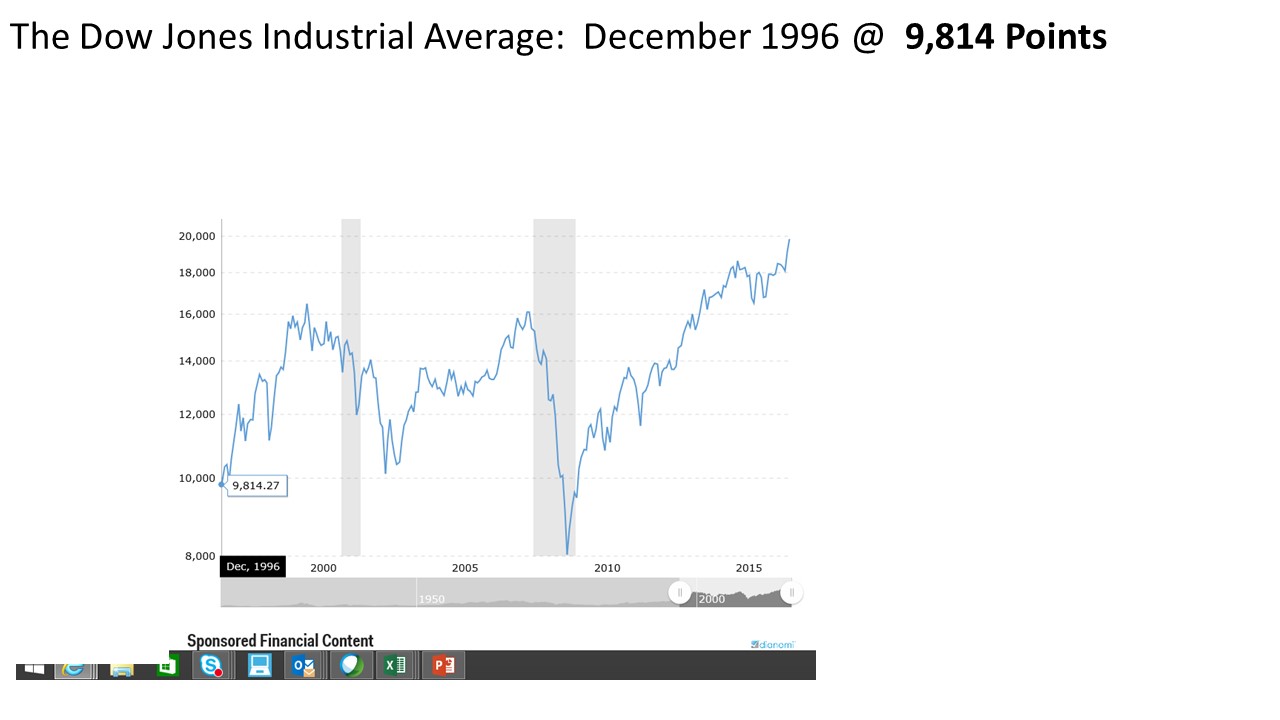
The Dow Jones: The Power of The Index

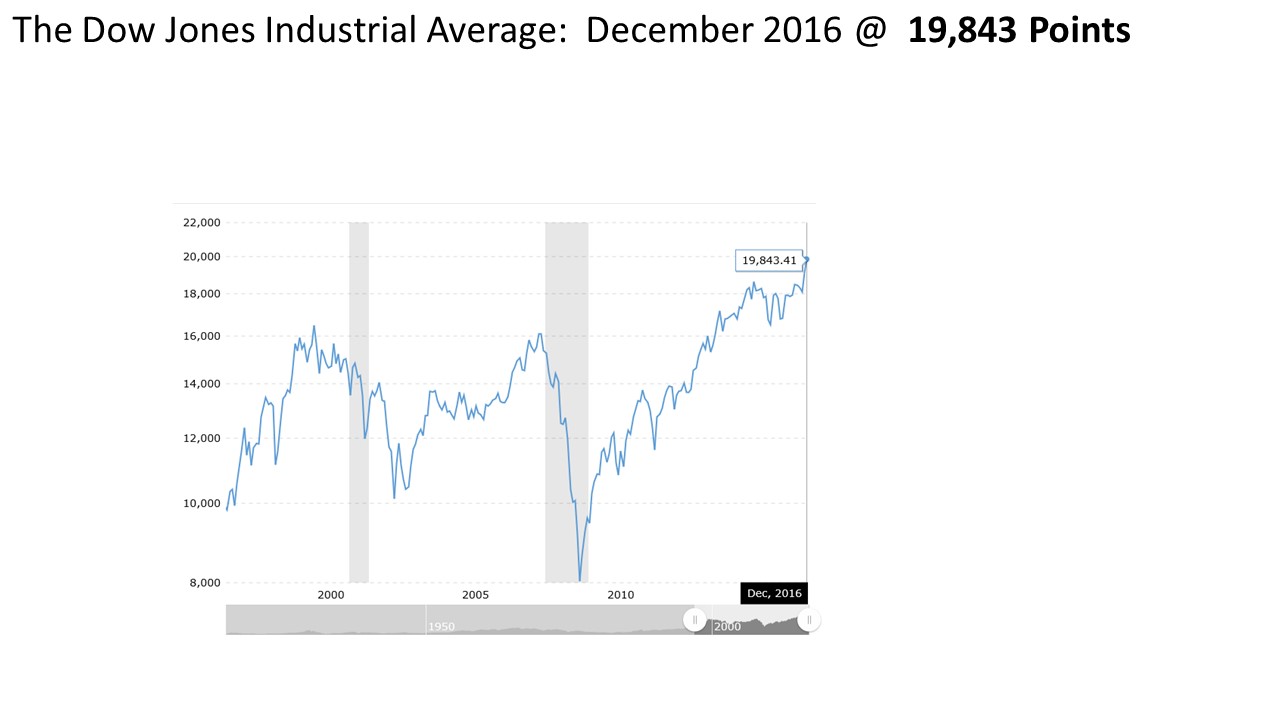
Imagine if one invested in a tracker fund that tracked the Dow Jones Industrial Index, 20 years ago:

dow-1996jpg

The Dow 30 was at 9, 814. In December 1996

Now if one held that fund, today, 20 years on :-


dow2016

The index is at 19, 843 in December 2016

The index has more than doubled in 20 years. With hindsight it was a one way bet. Your money has more than doubled, with dividends from these companies in the index. Praise to Jack Bogle.


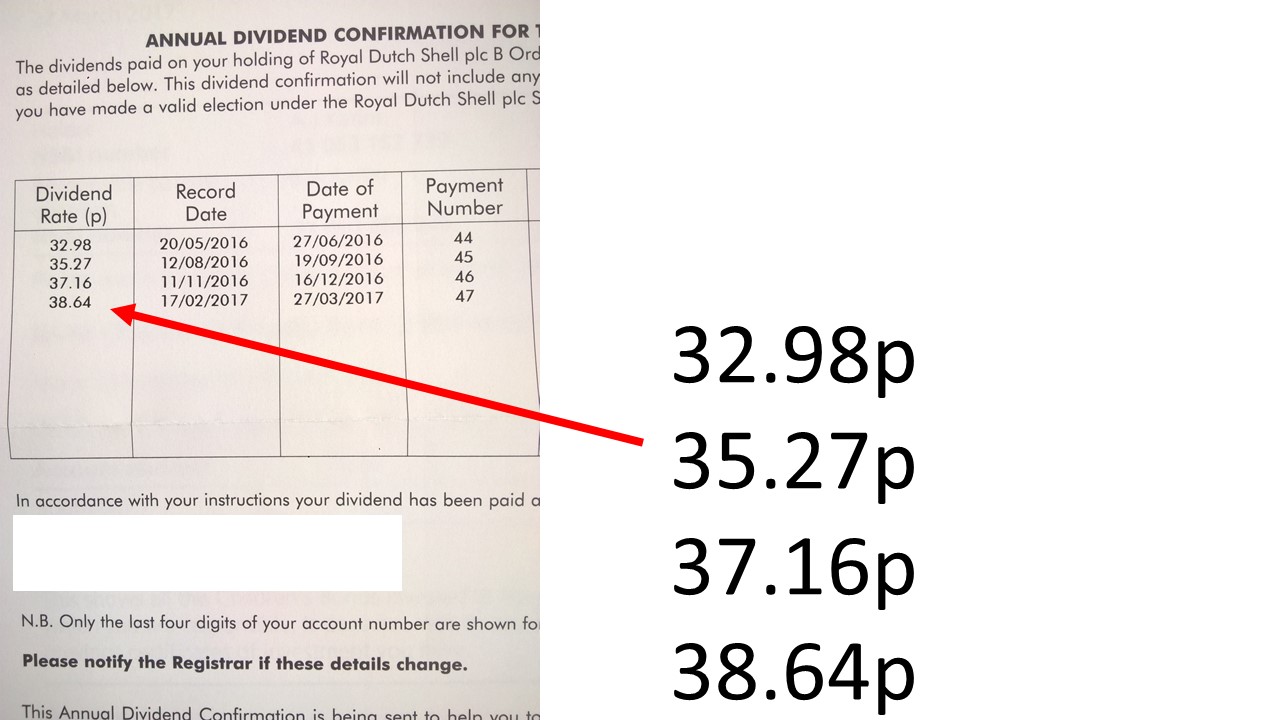
Devaluation of Sterling on the Shell PLC dividend.

Yesterday, Friday 16th December, Royal Dutch Shell, paid it’s third quarter dividend.
The quarterly dividend in 2016, has remained stable at $0.47 a share.

In September the 2nd quarter dividend was the stable figure of $0.47 which equated at the UK Sterling exchange rate at the time of 35.27p per share.

Yesterday Shell paid out $0.47 per share, but the UK Sterling exchange rate was 37.16p per share.

What you can see is the real affect of the devaluation of Sterling.

Someone with 100 shares in September would have got: £35.27

That same person yesterday with the 100 shares would have got: £37.16

That is an increase of over 5% in 3 months for doing NOTHING

Fidelity Asian Values PLC

Fidelity Asian Values PLC is a London listed investment trust, worth £220m

http://www.shareshop.hsbc.co.uk/shareshop/security.cgi?username=&ac=&csi=11817&record_search=1&search_phrase=fas

Launched in 1996.

It’s top ten holdings are:-

POWER GRID CORP OF INDIA LTD
TISCO FINANCIAL GROUP PCL
COGNIZANT TECH SOLUTIONS
TAIWAN SEMICONDUCTR MFG CO
HOUSING DEV FINANCE CORP LTD
WPG HOLDING CO LTD
RHT HEALTH TRUST
ASCENDAS INDIA TRUST
LT GROUP INC
SK HYNIX INC

How the shares trade at 10% discount to the assets. Thus the share price is reflecting 90% of the real value of the assets.

The UK Housing Market

The UK has a major issue regarding rampant house price inflation. The link between salaries and actual house prices is now gone.

For example in 1997,a graduate earning say £18,000 could afford to buy a house that was on the market for £55,000 in East Anglia.
The 3.5 times multiple of salary to house price meant one could buy that £55,000 house.

Today, the situation is that a new graduate earning £28,000 in East Anglia, could not afford a house, as that £55,000 in 1997 is now on the market for £200,000

Madness.

Why ?

The simple reality is not enough supply of new houses. A major cause and rarely mentioned by the politicians is that the our aging population live in incorrectly dimensioned homes.
A family house, say a 4 bedroom house, that once housed a full family, is now occupied by an elderly couple or just one person.

These homes are not coming onto the market for younger people, thus lack of supply of family homes.

All time highs of the S&P 500.

The Standard and Poors 500 Index (The USA’s largest 500 companies) has done exceptionally well.

S&P 500 rose is at about 2,240, an all time high.

The S&P 500® is widely regarded as the best single gauge of large-cap U.S. equities.
Within this index assets comprising approximately US$ 2.2 trillion of this total.
The index includes 500 leading companies and captures approximately 80% coverage of available market capitalisation

http://us.spindices.com/indices/equity/sp-500

The top ten companies in the S&P 500. are:

Apple
Microsoft
Exxon Mobile
Johnson & Johnson
Berkshire Hathaway B
Amazon.com
JP Morgan chase & Co
General Electric
Facebook
Wells Fargo

HSBC Dividend Dec 2016 Dividend

Yesterday, HSBC Holdings paid out its third interim dividend to shareholders.

It paid out US $0.10 = £0.080417

The total number of voting rights in HSBC Holdings plc is 19,805,075,710 shares.

So the dividend paid to shareholders:-

19,805,075,710 shares x £0.080417 =£1,592,664,773.37

That is £1.592 Billion cash paid out to shareholders.

Greencoat UK Wind PLC

Greencoat UK Wind PLC is a London listed Windfarm operator.

http://www.greencoat-ukwind.com/

Worth over £850 Million.

Offering a yield of over 5.4%

http://www.shareshop.hsbc.co.uk/shareshop/security.cgi?csi=7013076

The Portfolio consists of interests in nineteen wind farms located in the UK, together having an aggregate net installed capacity of 420.1MW. All of these assets are onshore except for Rhyl Flats.

Greencoat carries total debt of £245m, a portfolio generating sufficient electricity to power 375,000 homes.

HM Government November Borrowings

Another month, guess what, take a lucky guess, it is the same old story, HM Government, spends more money than it receives via taxes and duties. Another deficit month, thus to bridge the gap, needs to borrow on the bond market.

In November 2016, the HM Government had to borrow money to meet the difference between tax revenues and public sector expenditure. The term for this is The PSNCR: The Public Sector Net Cash Requirement.

There were “only” 4 auctions of Gilts (UK Government Bonds) by the UK Debt Management Office (http://www.dmo.gov.uk/) to raise cash for HM Treasury:-

22-Nov-2016 1½% Treasury Gilt 2026 £2,874.9960 Million
17-Nov-2016 0 1/8% Index-linked Treasury Gilt 2026 £1,100.0000 Million
08-Nov-2016 1¾% Treasury Gilt 2037 £2,711.0900 Million
01-Nov-2016 0½% Treasury Gilt 2022 £2,750.0000 Million

[http://www.dmo.gov.uk/reportView.aspx?rptCode=D2.1prof7&rptName=47806644&reportpage=Summary_of_results]

When you add the cash raised:-

∑(£2,874.9960  Million + £1,100.0000 Million + £2,711.0900 Million + £2,750.0000  Million =  9,436.086 Million

£9,436.086 Million = £9.436086 Billion

On another way of looking at it, is in the 30 days in November, HM Government borrowed:-

£314 million each day for the 30 days.

We are fortunate, while the global banking and financial markets still has the confidence in HM Government to buy the Gilts (Lend money to the UK), the budget deficit keeps rising. What is also alarming, is the dates these bond mature 2022, 2026, and 2043. All long term borrowings, we are mortgaging our futures, but at least “We are in it together…

The Twenty Four Income Fund

The TwentyFour Income Fund is a closed-ended investment fund managed my Twenty Four Asset Management. TFIF is the ticker symbol

£428.2m of assets

http://www.shareshop.hsbc.co.uk/shareshop/security.cgi?csi=6340436&action=

A yield of 6.5%

Top Ten Holdings are:-

CBFLU 1 BTL RMBS 3.32%
SCGC 2015-1 Consumer ABS 3.22%
LUSI 5 Prime RMBS 3.05%
AURUS 2016-1 Consumer ABS 2.67%
WARW 1 NC RMBS 2.63%
TPMF 2016-GR1 Prime RMBS 2.12%
MPS 3 NC RMBS 2.04%
AMF 2015-1 BTL RMBS 1.97%
SCGC 2016-1 Consumer ABS 1.95%
CELES 2015-1 BTL RMBS 1.95%

and pays our quarterly.

Aviva PLC November Dividend.

Aviva PLC is one of the UK’s largest insurers. Its origins are Commercial Union, Norwich Union, General Accident, Morley Fund Management, Hill House Hammond to name just a few names from the past.

http://www.aviva.com

The dividend paid was 7.42p per share.

The issued share capital of Aviva PLC is 4,058,275,949 shares.

Thus cash leaving the business to shareholders is:-

4,058,275,949 x £0.0742 = £301,124,075.42

That is £301 million pounds in cash to the shareholders of Aviva PLC

UK National Debt.

The UK media have been covering the UK Government Debt.

The figure is £1.64 Trillion

To be simple:-

£1.64   Trillion
£1,640   Billion
£1,640,000 Million

Now this debt is formed by the UK Debt Management office, (http://www.dmo.gov.uk) issuing blocks of Bonds, (gilts) to fund the UK.
This £1,640,000 Million is formed of literally hundreds of blocks of debt, issued monthly.

In the style of keeping things simple, if the interest rate was 1.25% on this £1,640,000 Million, then just the interest payments annually would be  £20,500 Million

That is £20.5 Billion

That is actually an under estimate of the interest payments, but it is the order of magnitude of interest HM Government has to pay on its debt mountain. Money that pays the creditors.

With a UK Population of 60 Million.

That debt of £1,640,000 Million equates to £27,333 per UK Person.
The interest of £20,500 Million equate to £341 per UK Person per year.

UK Government Running Budget Deficits for years to come.

On Wed 23rd November, the UK Government gave it’s Autumn Statement.

https://www.gov.uk/government/topical-events/autumn-statement-2016

What is true is that the HM Government, will spend more money that it earns. Thus expenditure will exceed income, but how by how much ?

Office for Budget Responsibility (OBR) forecasts:

http://budgetresponsibility.org.uk/

£68.2bn in 2016-17
£59.0bn in 2017-18
£46.5bn in 2018-19
£21.9bn in 2019-20
£20.7bn in 2020-21

So over the next 5 years, the UK National debt will GROW by £216.3 Billion. But it remember, we are in it together.

Vida Home Loans.

A new mortgage lender has opened up for business.

http://www.vidahomeloans.co.uk/

Founded and financed by Belmont Green

http://www.belmontgreen.co.uk/

Vida Homeloans will be a wholesale-funded lender that will only distribute through intermediaries, the source of capital is Pine Brook, which is a New York-based private equity firm.

http://www.pinebrookpartners.com/

It’s customer based will be the self-employed, contractors, employees with a short work histories, buy together for more than two applicants and borrowing in or into retirement.

More customer choice, and a mortgage provider for customers traditionally shut out of the mortgage market.

The United States of America

The United States of America is the home to the most dynamic economy. The nation has created household names like Verizon, Time Warner, AT&T, Ford, BNC Holdings, General Motors, BT Private Wires, IBM, Johnson & Johnson, Cisco Systems to name just a few.

It is also home to CNN.


The Withdrawal of Legal Tender Character of Indian Rupee 500 & Indian Rupee 1,000

The Indian Central Bank, The Reserve Bank of India has taken a huge step to clean up the economy.

https://www.rbi.org.in/Scripts/BS_PressReleaseDisplay.aspx?prid=38520

On the 8th November, The Reserve Bank of India issued this statement.

This is necessitated to tackle counterfeiting Indian banknotes, to effectively nullify black money hoarded in cash and curb funding of terrorism with fake notes

It has effectively sent a message to the world that the Indian Economy is open for business. Black Market Cash is no longer tolerated. This is a huge step for India where cash is the main form of currency that is used.

On thing that this may facilitate is the long term trend to stop using cash and the use of electronic money.

Esure Group PLC

Esure Group PLC

ESure is the FTSE-250 insurer that is the owner of GoCompare.com

http://www.esure.com

It collects £320.4m in insurance premiums. It has an investment portfolio to help meet its potential liabilities.

Cash & Liquidity of £210m [27%]
Fixed Income £525m [67%]
Equities £43m [6%]

Total £778m

“….Group’s conservative asset allocation focusing on higher rated credit quality bonds”

Interesting to see the low exposure to shares.

http://www.shareshop.hsbc.co.uk/shareshop/security.cgi?csi=6853112

4% yield.

The Cost of Financing AT&T Debt.

AT&T the American Telecommunications giant has a large debt mountain.

http://www.att.com/Common/about_us/files/pdf/investor_relations/debt_list_2q16.pdf

The total debt is a staggering $126,835,952,257 ($126 Billion).

However what is very interesting is the cost of the debt, (the interest payments).

http://www.asadkarim.co.uk has calculated the annual interest on all the 124 Bonds that are still outstanding that adds up to the $126 Billion.

The annual cost of interest payments are actually:-

$4,996,447,892

That is just under $5bn a year to AT&T.

The revenues of AT&T are about $146.8 billion.

So the actual debt burden which may seem large at $126,835,952,257, when interest rates are low, and the cash flow is strong, one can safely say $4,996,447,892 is fine.

The Devaluation of Sterling against the Euro.

Imagine before the June 23rd 2016, you held £100,000 in cash.

Around about the 1st June, £1 = €1.30

Thus £100,000 sold to buy Euro’s would have converted to €130,000

So, imagine 5 months on, that €130,000 is converted back into Sterling.

Today £1 = € 1.12.

So:

€130,000 converted back to UK £ = 115,760.

Thus a potential gain of £15,760.

UK National Debt: The Office of Budget Responsibility.

The UK National Debt is a topic that is not widely reported. However the UK as a whole is a highly indebted nation.

http://budgetresponsibility.org.uk/docs/dlm_uploads/August-2016-Commentary-on-the-Public-Sector-Finances-release.pdf

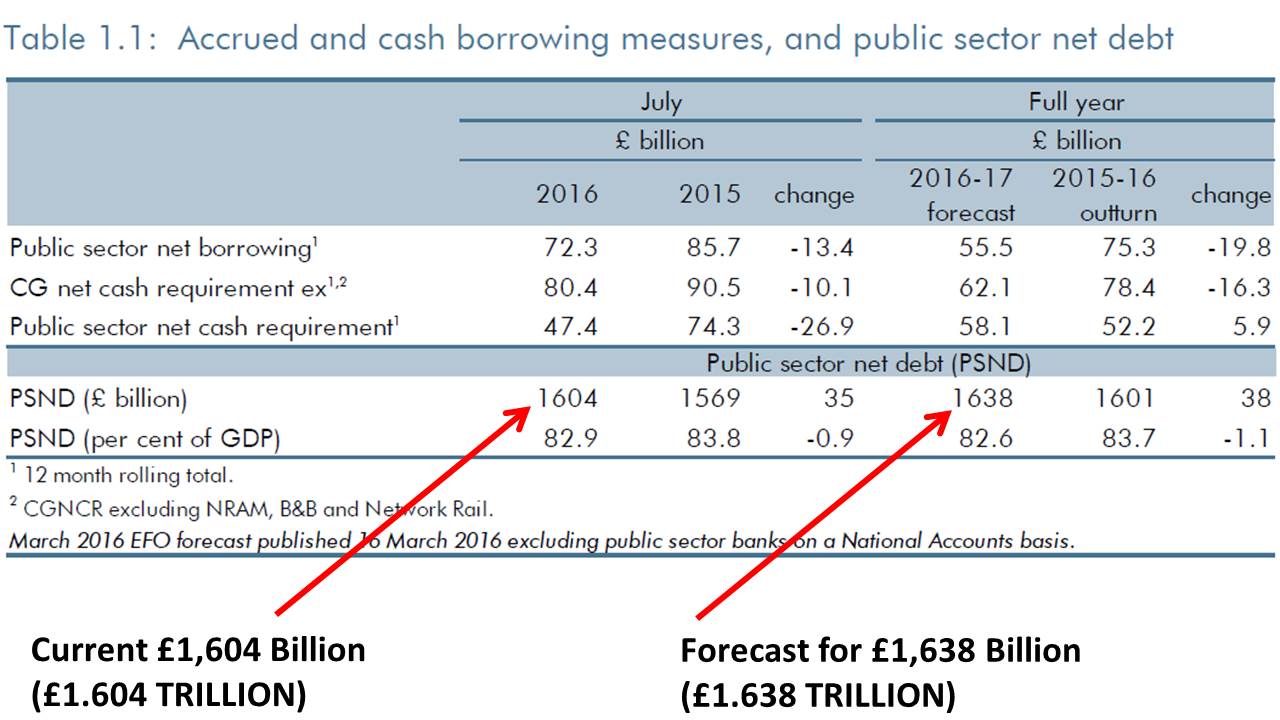
The figures here are worrying.

uknationaldebt

So the UK spends more than it earns (revenues from taxation and duties)

Currently the UK is carrying £1,604 Billion of debt, and by March 31st 2017, the UK is forecast to spend another £34 Billion to take the current debt from £1,604 Billion to £1,638 Billion.

This debt is constantly accruing interest that is paid to the UK creditors. Remember, we are in it together.

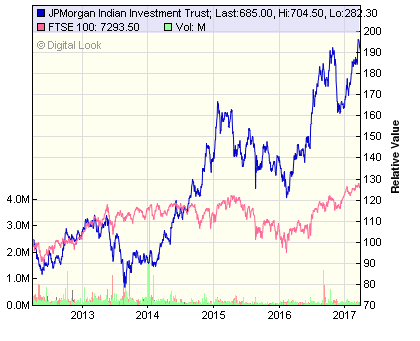
The JP Morgan Indian Investment Trust PLC

The JP Morgan Indian Investment Trust PLC is a £670m London listed investment trust.

http://am.jpmorgan.co.uk/investment-trusts/trusts/indian-jpm-it.aspx?isin=GB0003450359

Top 10 Holdings

HDFC Bank Ltd. 7.79%
Housing Development Finance Corp. 6.78%
Infosys Technologies, Ltd. 6.38%
Tata Consultancy Services 5.16%
Ultra Tech Cement Ltd. 4.86%
IndusInd Bank Ltd. 4.66%
Sun Pharmaceutical 4.55%
Kotak Mahindra Bank 4.25%
ACC Limited 4.15%
Maruti Suzuki India Ltd 4.15%

http://www.shareshop.hsbc.co.uk/shareshop/security.cgi?username=&ac=&csi=11885&record_search=1&search_phrase=Indian Investment Trust

HM Government Borrowings: October 2016

Another month, guess what, take a lucky guess, it is the same old story, HM Government, spends more money than it receives via taxes and duties. Another deficit month, thus to bridge the gap, needs to borrow on the bond market.

In October 2016, the HM Government had to borrow money to meet the difference between tax revenues and public sector expenditure. The term for this is The PSNCR: The Public Sector Net Cash Requirement.

There were “only” 4 auctions of Gilts (UK Government Bonds) by the UK Debt Management Office (http://www.dmo.gov.uk/) to raise cash for HM Treasury:-
19-Oct-2016 1½% Treasury Gilt 2026 £2,500.0000 Million
12-Oct-2016 0 1/8% Index-linked Treasury Gilt 2036 £850.0000 Million
06-Oct-2016 1½% Treasury Gilt 2047 £2,000.0000 Million
04-Oct-2016 0½% Treasury Gilt 2022 £2,819.6750  Million
When you add the cash raised:-

∑(£2,500.0000 Million + £850.0000 Million + £2,000.0000 Million + £2,819.6750  Million =  8,169.68 Million

8,169.68 Million = £8.196 Billion

On another way of looking at it, is in the 31 days in October, HM Government borrowed:-

£263 million each day for the 31 days.

We are fortunate, while the global banking and financial markets still has the confidence in HM Government to buy the Gilts (Lend money to the UK), the budget deficit keeps rising. What is also alarming, is the dates these bond mature 2022, 2026, 2036 and 2047. All long term borrowings, we are mortgaging our futures, but at least “We are in it together…

UK Mortgages October Dividend.

UK Mortgages PLC is an investment fund managed by Twenty Four Asset Management.

http://www.twentyfouram.com/funds-and-services/uk-mortgages-ltd

Today UK Mortgages is paying out 1.5p per share for it’s October Dividend.

http://www.londonstockexchange.com/exchange/news/market-news/market-news-detail/UKML/12998846.html

UK mortgages has an issued share capital of 250,031,969 shares.

Thus today, its is paying out:-

250,031,969 x 0.015 = £3,750,479.53 to its shareholders.

that is £3.75m cash.

RIT Capital Partners October Dividend

RIT Capital Parnters PLC is the Rothschild Investment Trust that is member of the FTSE-250 Index. It has substantial stake of the personal wealth of The Rothschild family.

http://www.ritcap.com/

With assets of £2,614m, yesterday it paid its dividend to shareholders 15.5p per share.

with 155,351,431 shares issues, it paid out:-

155,351,431 x £0.155 = £24,079,471.81

That is £24m

http://www.shareshop.hsbc.co.uk/shareshop/security.cgi?username=&ac=&csi=10281&record_search=1&search_phrase=rit

A yield of 1.7%

The Debt of Time Warner

Time Warner, the owner of the HBO and CNN network is now subject to a take over from AT&T.

http://www.timewarner.com

The financials of Time Warner are interesting.

http://ir.timewarner.com/phoenix.zhtml?c=70972&p=irol-debt

It’s debt position is interesting:-

Coupon Maturity Face Amount $m
7.25%    10/15/17    $500
9.15%     2/1/23       $602
7.57%    2/1/24        $450
6.85%    1/15/26      $28
6.95%    1/15/28      $500
8.30%    1/15/36     $200
6.88%     6/15/18    $600
6.63%     5/15/29    $1000
2.10%     6/1/19      $650
4.88%     3/15/20   $1400
4.70%     1/15/21   $1000
4.75%     3/29/21   $1000
4.00%     1/15/22    $500
3.40%     6/15/22    $500
1.95%     9/15/23   $700
4.05%    12/15/23  $500
3.55%    6/1/24     $750
3.60%    7/15/25   $1500
3.88%    1/15/26    $600
2.95%     7/15/26   $800
7.63%    4/15/31   $2000
7.70%   5/1/32     $2000
6.50%   11/15/36  $1000
6.20%    3/15/40   $600
6.10%    7/15/40  $1000
6.25%   3/29/41   $1000
5.38%   10/15/41  $500
4.90%    6/15/42   $500
5.35%    12/15/43  $500
4.65%    6/1/44       $600
4.85%    7/15/45    $900
Total : $23,680m

AT&T Buys Time Warner, and will take on the $23.68 Billion of Time Warner debt.

The Debt of AT&T

The American Telephone and Telegraph Company (AT&T) has announced its plans to buy Time Warner, the owner of HBO and CNN. AT&T is a part of American history. It is a giant, a pioneer, and has followed the innovations of strategy of the global leader in telecoms and media, British Telecommunications PLC.

http://www.bt.com

Interesting to understand some very basic financials of AT&T.

Number of shares of AT&T: 6,150,000,000 (that is 6.15 Billion shares)
Share Price: $37.49

Market Capitalisation (Value) = 6,150,000,000 x $37.49 = $230,563,500,000

That is $230 Billion.

Now what is the debt of AT&T ?

http://www.att.com/Common/about_us/files/pdf/investor_relations/debt_list_2q16.pdf

That is $126,835,952,257

Yes, $126.8 Billion.

The Standard Life Equity Income Trust

The Standard Life Equity Income Trust is a £188m London listed investment trust.

http://uk.standardlifeinvestments.com/ifa/funds/investment_trusts/standard_life_equity_income_trust_plc.html

It’s top 20 holdings make up 50% of its total investments:-

BT 4.2%
Sage 4.2%
Vodafone 3.2%
RELX 3.0%
Aviva 2.7%
Micro Focus 2.6%
Rio Tinto 2.5%
Imperial Brands 2.4%
Supergroup 2.3%
Legal & General 2.2%
Close Brothers 2.2%
Beazley 2.2%
Saga 2.2%
River & Mercantile 2.1%
Prudential 2.1%
Britvic 2.0%
Tyman 2.0%
Safestyle UK 2.0%
NewRiver Retail 1.9%
National Grid 1.9%

http://www.shareshop.hsbc.co.uk/shareshop/security.cgi?csi=50887&action=

A yield of 3.5% in times of 0.25% base rate.

Standard Life’s October Dividend.

Today, Standard Life paid out its October Dividend. 6.47p per share.

http://www.standardlife.com

Standard Life’s issued share capital consists of 1,975,668,483 ordinary shares. A useful note is that Standard Life manages the BT Defined Contribution Pension Scheme, the BT Retirement Savings Scheme.

http://www.btretirementsavingscheme.com/

BT, the world’s most dynamic, media and telecommunications corporation

http://otp.investis.com/clients/uk/standardlife1/rns/regulatory-story.aspx?cid=65&newsid=801413

Thus today, the dividend cost Standard Life:

1,975,668,483 x £0.0647 = £127,825,750.85

http://www.shareshop.hsbc.co.uk/shareshop/security.cgi?csi=186960&action=

That is £127m cash. A yield of over 5%.

The Honeycomb Investment Trust plc

The Honeycomb Investment plc is a specialist lending fund which seeks to provide shareholders with an attractive level of dividend income and capital growth through the acquisition of interests in loans make to consumers, small businesses and other counterparties in specialist lending market segments which are underserved by mainstream lenders.

http://www.honeycombplc.com/

The investment manager is Pollen Street Capital Limited.

The loans originate from:-

http://www.honeycombfinance.com/

It is these loans that are then bought by the Honeycomb Investment Trust plc.

Its portfolio is:-

Top 10 Holdings:-

Consumer Loans –Secured Loans 64.92%
Consumer Loans –Unsecured Loans 14.91%
Micro SME Loans Loans 9.00%
Organic Originations Loans 6.97%
Freedom Finance Limited Equity 1.81%
Pay4Later Equity 1.33%
Cash 1.06%

Total 100.00%

http://www.shareshop.hsbc.co.uk/shareshop/security.cgi?csi=49066786&action=

The Fundsmith Emerging Equities Trust

The Fundsmith Emerging Equities Trust is a £230m London listed investment fund, run by Terry Smith

https://www.feetplc.co.uk/

Top five holdings are:-

Marico
GrupoLaLa
Godrej
Hypermarcas
Vitasoy

Its geographic split is:-

Asia 55%
Europe, Middle East, Africa 26%
Latin America 11%
Cash 8%

Total 100%

http://www.shareshop.hsbc.co.uk/shareshop/security.cgi?csi=32594589&action=

The Scottish American Investment Company PLC

The Scottish American Investment Company PLC is a London listed £400m investment trust. it is managed by Baillie Gifford & Co Limited, the Edinburgh-based investment firm.

https://www.bailliegifford.com/individual-investors/funds/scottish-american-investment-company/

The top ten holdings are:

1 Coca Cola 2.5%
2 WPP Group 2.4%
3 TSMC ADR 2.4%
4 Johnson & Johnson 2.0%
5 Procter & Gamble 1.9%
6 Sonic Healthcare 1.8%
7 Kimberly-Clark De Mexico 1.8%
8 Linear Technology 1.8%
9 Partners Group 1.8%
10 Pepsico 1.7%

Makes up 19.9% of the fund.

http://www.shareshop.hsbc.co.uk/shareshop/security.cgi?csi=10289&action=

a 3.6% yield.

The Phoenix Group

The Phoenix Group is a UK FTSE-250 Listed Life Assurance company, that buys closed life books.

http://www.thephoenixgroup.com/

It has around 4.5 million policyholders and £52 billion assets.

On Wed 28th September, Phoenix announced it was buying Abbey Life from Deutsche Bank who are in the eye of current storm.

http://www.thephoenixgroup.com/investor-relations/proposed-acquisition-of-abbey-life.aspx

Interesting to see the debt structure of Phoenix Life.

http://www.thephoenixgroup.com/~/media/Files/P/Phoenix-Group-v3/Attachments/pdf/2015-phoenix-group-debt-investor-update.pdf

yes, total debt of £12,148 Million

Phoenix offers its shareholders an yield of 3%.

http://www.shareshop.hsbc.co.uk/shareshop/security.cgi?csi=2366179&action=

HM Government Borrowings: September 2016

Another month, guess what, take a lucky guess, it is the same old story, HM Government, spends more money than it receives via taxes and duties. Another deficit month, thus to bridge the gap, needs to borrow on the bond market.

In September 2016, the HM Government had to borrow money to meet the difference between tax revenues and public sector expenditure. The term for this is The PSNCR: The Public Sector Net Cash Requirement.

There were “only” 4 auctions of Gilts (UK Government Bonds) by the UK Debt Management Office (http://www.dmo.gov.uk/) to raise cash for HM Treasury:-

20-Sep-2016 1½% Treasury Gilt 2047 £2,874.9990 Million
14-Sep-2016 0 1/8% Index-linked Treasury Gilt 2046 £800.0000 Million
06-Sep-2016 1½% Treasury Gilt 2026 £2,874.9970 Million
01-Sep-2016 0½% Treasury Gilt 2022 £3,150.8860 Million

When you add the cash raised:-

∑(£2,874.9990 Million + £800.0000 Million + £2,874.9970 Million + £3,150.8860 Million =  9700.882 Million

9700.882 Million = £9.700882 Billion

On another way of looking at it, is in the 30 days in September, HM Government borrowed:-

£223 million each day for the 30 days.

We are fortunate, while the global banking and financial markets still has the confidence in HM Government to buy the Gilts (Lend money to the UK), the budget deficit keeps rising. What is also alarming, is the dates these bond mature 2022, 2026, 2046 and 2047. All long term borrowings, we are mortgaging our futures, but at least “We are in it together…

The Decline in Revenues Year on Year at Royal Dutch Shell

Royal Dutch Shell is one of the largest energy companies in the world.

http://www.shell.com

It has two share classes, Shell A for Dutch shareholders and Shell B for UK Shareholders.

http://www.shareshop.hsbc.co.uk/shareshop/security.cgi?csi=133655
[Shell A]

http://www.shareshop.hsbc.co.uk/shareshop/security.cgi?csi=133755
[Shell B]

Look at the revenues:-

31-Dec-11 $470,171 Million
31-Dec-12 $467,153 Million
31-Dec-13 $451,235 Million
31-Dec-14 $421,105 Million
31-Dec-15 $264,960 Million

One can see year on year, the effect of falling energy prices affecting the revenues of Royal Dutch Shell

Wealth Inequality in the USA.

The largest economy in the world is the United States of America. It is also the most generous nation, whenever in the world their is a natural disaster, the USA are the first nation to send emergency aid.

What is happening now in the world, is the growth of the 1%.

https://www.youtube.com/watch?v=vttbhl_kDoo

The 1% population are now owning more and more assets that the rest of society. A trend that we are seeing all over the world. The concentration of money and assets in the hands of so few can not be a good trend.

5 Year Performance of the FTSE-All Share.

The FTSE-All Share index is the broadest barometer index of the UK’s listed companies.

http://www.shareshop.hsbc.co.uk/shareshop/security.cgi?username=&ac=&csi=50100&record_search=1&search_phrase=ASX

Interesting to see the long term trend.

http://www.londonstockexchange.com/exchange/prices-and-markets/stocks/indices/summary/summary-indices.html?index=ASX&lang=en

on 3rd July 2012 it was 2951

on 4th July 2016 it was 3518

One can see the trend of year on year growth, the benefit of investing in a tracker.

President Obama Quote

President Obama has made a great investment quote:-

Cutting the US Federal deficit by gutting our investments in innovation and education is like lightening an overloaded airplane by removing its engine. It may make you feel like you’re flying high at first, but it won’t take long before you feel the impact.”

The Legal and General Sept 2016 Dividend.

On Thursday 22nd September, Legal and General PLC paid 4p to its shareholders

http://www.legalandgeneral.com

Legal and General’s capital consisted of 5,952,449,117 Ordinary shares of 2.5p each, with voting rights.

http://phx.corporate-ir.net/phoenix.zhtml?c=67701&p=irol-rnsArticle&ID=2198957

Thus:-

5,952,449,117 x £0.04 = £238,097,964.68

That is £238million paid to it’s shareholders.

http://www.shareshop.hsbc.co.uk/shareshop/security.cgi?csi=10055&action=

That is a yield of 6%

The Shell PLC September Quarterly Dividend

On Monday 19th Sept 2016, Shell PLC paid out its quarterly dividend to its shareholders.

It has who classes of shares, Shell A and Shell B.

Shell A

http://www.shareshop.hsbc.co.uk/shareshop/security.cgi?csi=133655

Shell B

http://www.shareshop.hsbc.co.uk/shareshop/security.cgi?csi=133755
It paid out $0.47 per share for each share, that is 35.27p per share.
Now, Royal Dutch Shell plc’s capital consists of 4,325,899,655 A shares and 3,745,486,731 B shares.

Thus:

Shell A = 4,325,899,655 x £0.3527 = £1,525,744,808.32
Shell B = 3,745,486,731 x £0.3527 = £1,321,033,170.02

Total paid out: £2,846,777,978.34

That is £2.846 Billion paid out to its shareholders in Shell A and Shell B

Picton Property Income

The Picton Property Income is a £375m London listed property investment company owning commercial real estate.

http://www.picton.co.uk/

38.6% in Office space
36.1% in Industrial space
25.3%in Retail and Leisure space.

10 ten tenants are:

1 Belkin Limited 4.2%
2 B&Q Plc 3.1%
3 DHL Supply Chain Limited * 2.8%
4 Snorkel Snorkel Europe Limited 2.5%
5 The Random House Group Limited 2.5%
6 Cadence Design Systems Limited 2.4%
7 Trainline.com Limited 2.1%
8 Portal Chatham LLP 2.0%
9 Stanfords Edward Stanford Limited 1.9%
10  GLH Hotels Limited 1.9%

Total  25.4%

http://www.shareshop.hsbc.co.uk/shareshop/security.cgi?username=&ac=&csi=139224&record_search=1&search_phrase=picton

A yield of over 4.5%.

BP’s September 2016 Dividend.

Yesterday, (Fri 16th Sept) BP PLC paid its second quarterly dividend.

http://www.bp.com

The dividend is £0.075578 per share.

The share capital of BP PLC comprised 18,784,467,284 ordinary shares.

http://otp.investis.com/clients/uk/bp_plc/rns/regulatory-story.aspx?cid=233&newsid=778298

Thus

18,784,467,284 ordinary shares x £0.075578  = £1,419,692,468

That is £1,419 Million = £1.419 Billion paid out.

Bank of England Asset Purchase Facility – Corporate Bond Purchase Scheme

On Tue 13th Sept 2016, The Bank of England announced what Bonds it was willing to buy from the market as part of its Asset Purchase Facility.

http://www.bankofengland.co.uk/markets/Pages/apf/corporatebondpurchases/default.aspx

The XLS with all the names of the debt instruments it is willing to buy is here:-

http://www.bankofengland.co.uk/markets/documents/cbeligiblesecurities.xls

271 Bonds of a total debt outstanding worth £110,012 million is what makes up this list. It will be interesting to see which institutions who currently own these bonds are willing to sell them to The Bank of England.

They are all famous names what are clearly high quality debtors.

To name a selected few of bonds that The Bank of England is will to buy:-

BRITISH TELECOM PLC (the  world’s most dynamic telecommunications and media corporation)
APPLE INC
ASTRAZENECA PLC
AT&T INC
DEUTSCHE TELEKOM INT FIN
GLAXOSMITHKLINE CAPITAL
NATIONAL GRID GAS PLC
ROLLS-ROYCE PLC
TOYOTA MOTOR CREDIT CORP
TRANSPORT FOR LONDON
VERIZON COMMUNICATIONS
VODAFONE GROUP PLC
WAL-MART STORES INC

So if The Bank of England buys any of these bonds, it then becomes a creditor to these institutions.

Astra Zeneca Dividend

Astra Zeneca is the FTSE-100 Pharmaceuticals giant. Yesterday (Mon 12th Sept) it paid out its dividend to its shareholders.

http://www.astrazeneca.com

Yesterday, it paid out 68.7p a share.

The issued share capital of AstraZeneca PLC with voting rights is 1,264,983,797 ordinary shares.

https://otp.tools.investis.com/clients/uk/astrazeneca/rns/regulatory-story.aspx?cid=1343&newsid=778686

Thus:-

1,264,983,797 x £0.687 = £869,043,868.54

Astra Zeneca paid out £869 million to its shareholders.

http://www.shareshop.hsbc.co.uk/shareshop/security.cgi?csi=10009

That is a yield of 4.4%

Cisco Systems

Cisco is the American technology giant whose electronics, (Routers and Switches) form the backbone to the internet and modern telecommunications

http://www.cisco.com

Worth about $155 bn

http://investor.cisco.com/investor-relations/overview/default.aspx

What is interesting is the financials of the company

http://s2.q4cdn.com/230918913/files/doc_financials/quarterly/Q4FY16/FY16-Balance-Sheet.xls

The balance sheet financials are amazing:-

Cash: $7.631 Billion
Investments: $58.125 Billion

That is $67.756 Billion in pure liquidity.

Long term debt of  $24.483 Billion.

Incredible.

BT’s September 2016 Dividend

Today, Sept 5th, BT plc, the most dynamic, media, broadband, mobile and global telecommunications provider paid out 9.6p to its shareholders.

BT Group plc share capital consists of 9,968,127,681 ordinary shares with voting rights. BT Group plc held 40,523,643 ordinary shares as treasury shares and thus the total number of voting rights in BT Group plc on that date was 9,927,604,038.

http://hsprod.investis.com/servlet/HsPublic?context=ir.access&ir_option=RNS_NEWS&item=2550175486705664&ir_client_id=1281
What this means is that today BT plc paid out:-

9,927,604,038 x £0.096 = £953,049,987.60

That is £950 million in cash that leaves the bank account of BT plc to its loyal shareholders.

HM Government Borrowings: August 2016

Another month, guess what, take a lucky guess, it is the same old story, HM Government, spends more money than it receives via taxes and duties. Another deficit month, thus to bridge the gap, needs to borrow on the bond market.

In August 2016, the HM Government had to borrow money to meet the difference between tax revenues and public sector expenditure. The term for this is The PSNCR: The Public Sector Net Cash Requirement.

There were “only” 3 auctions of Gilts (UK Government Bonds) by the UK Debt Management Office (http://www.dmo.gov.uk/) to raise cash for HM Treasury:-

17-Aug-2016 4¼% Treasury Gilt 2055 £1,250 Million
11-Aug-2016 0 1/8% Index-linked Treasury Gilt 2036 £954.580 Million
02-Aug-2016 0½% Treasury Gilt 2022 £2,500 Million
When you add the cash raised:-

∑(£1,250 Million + £954.580 Million + £2,500 Million) =  £4,704,580 Million
Million

££4,704,580 Million = £4.704 Billion

On another way of looking at it, is in the 31 days in August, HM Government borrowed:-

£171 million each day for the 31 days.

We are fortunate, while the global banking and financial markets still has the confidence in HM Government to buy the Gilts (Lend money to the UK), the budget deficit keeps rising. What is also alarming, is the dates these bond mature 2022, 2036 and 2055. All long term borrowings, we are mortgaging our futures, but at least “We are in it together…

Low Cost Index Tracker Funds

Index Tracker Funds are amazing. Access to the world’s investment market in a single investment instrument

Legal and General have some great funds

http://www.legalandgeneral.com/investments/products-and-funds/index-tracker/

Ethical Trust.
European Index Trust.
Global 100 Index Trust.
Global Emerging Markets Index Fund.
Global Equity Index Fund.
Global Health and Pharmaceuticals Index Trust.
Global Technology Index Trust.
International Index Trust.
Japan Index Trust.
Pacific Index Trust.
UK 100 Index Trust.
UK Index Trust.
US Index Trust.
This man is a good advocate…..

https://www.youtube.com/watch?v=yk94tI_2QOY

The Standard Life Investments Property Income Trust Limited

The Standard Life Investments Property Income Trust Limited is a London Listed £300m property investment trust.

http://uk.standardlifeinvestments.com/ifa/funds/investment_trusts/standard_life_property_income_trust_limited.html

Its top then holdings are:-

White Bear Yard London, worth £18 -20m
Elstree Tower Borehamwood, worth  £16 -18m
Denby 242 Preston, worth  £16 -18m
Currys PC World Denby, worth  £16 -18m
Symphony Rotherham, worth  £14 -16m
Chester House Farnborough, worth  £14 -16m
Charter Court Slough, worth  £12 -14m
Bong UK Milton Keynes, worth  £10 -12m
Ocean Trade Centre Aberdeen, worth  £10 -12m
Bourne House Staines Upon Thames, worth  £10 -12m

http://www.shareshop.hsbc.co.uk/shareshop/security.cgi?username=&ac=&csi=51756&record_search=1&search_phrase=sli

A dividend yield of over 5%.

The Foreign and Colonial Commercial Property Trust

The Foreign and Colonial Commercial Property Trust is a London listed investment trust investing in real estate.

http://www.fandc.com/uk/private-investors/investment-trusts/property/fandc-commercial-property-trust/

A member of the FTSE-250 and is worth nearly £1,000 million.

http://www.shareshop.hsbc.co.uk/shareshop/security.cgi?username=&ac=&csi=112535&record_search=1&search_phrase=fc

Some salient facts.

A yield of nearly 5%.

Since launch in 2005, The F&C Commercial Property Trust Limited has turned a £1,000 investment, with dividends reinvested, into £2,503. It’s has a clever borrowing strategy. The F&C Commercial Property Trust, entered into a £260 million ten year loan agreement with Legal & General Pensions Limited on 31 December 2014, refinancing its previous £230 million bonds and a £30 million bank loan. The L&G loan carries a fixed interest rate of 3.32 per cent per annum. The Company also has a £50 million bank loan with a term to 28 June 2017 on which the interest rate is fixed, through an interest rate swap of the same notional value and duration, at 4.88 per cent per annum. The Group’s total borrowings amount in aggregate to £310 million.

Its cash flow is so strong it is able to pay dividends monthly. Its total rental income from its property was £62.613 Million.

It’s two largest shareholders are:

Aviva Group 22.7%
Investec Wealth & Investment Limited  9.8%

Potential Default on Bonds from The Manchester Building Society.

The Manchester Building Society is struggling in the 0.25% Base Rate climate.

http://www.themanchester.co.uk/

Apart from using deposits to fund mortgages, The Manchester Building Society, has issued Permanent Income Bearings Shares to raise cash, (PIBS). These are debt instruments.

In October 1999 the Society issued £5 million of PIBS. 5,000 individual shares were issued and each one had a nominal value of £1,000. In April 2005, a further £10 million of PIBS was issued. 10,000 individual shares were issued and each one had a nominal value of £1,000

http://www.londonstockexchange.com/exchange/prices-and-markets/debt-securities/company-summary/GB00B0712W15GBGBPSTBS.html?ds=0&lang=en

So it pays 6.75%

Look at the chart. A dramatic collapse is price.
http://www.londonstockexchange.com/exchange/prices-and-markets/debt-securities/company-summary/GB0008775057GBGBPSTBS.html?ds=0&lang=en

This one pays 8% to investors.

http://www.londonstockexchange.com/exchange/news/market-news/market-news-detail/MBSR/12927103.html

But it looks like they may miss the next payment. A default.

The Polar Capital Global Financials Trust

The Polar Capital Global Financials Trust is a FTSE Small Cap investment trust listed on the London Stock Exchange.

A £175m fund

http://www.polarcapitalglobalfinancialstrust.com/

Top 15 Holdings:-

JPMorgan 3.6% of the fund
Chubb 3.4% of the fund
Wells Fargo 3.0% of the fund
ING Groep 2.6% of the fund
Marsh & McLennan 2.3% of the fund
Fortune Real Estate Investment 2.2% of the fund
Swedbank 2.2% of the fund
Bank of America 2.1% of the fund
Sampo 2.0% of the fund
Toronto-Dominion 2.0% of the fund
Sumitomo Mitsui Financial 2.0% of the fund
First Republic Bank 2.0% of the fund
Citigroup 1.9% of the fund
BNP Paribas 1.9% of the fund
Discover Financial Services 1.8% of the fund

15 holdings make up 35.0 % of the fund

What is interesting is that the fund is at a discount.
Discount -13.91% to be precise.

Meaning you are buying £1 worth of assets for 86.09p.

http://www.shareshop.hsbc.co.uk/shareshop/security.cgi?csi=10625357&action=

A yield of over 3%

The Power of Index Funds

A great quote from the father of index funds, and the founder of Vanguard.

Don’t look for the needle in the haystack. Just buy the haystack!

Just an amazing quote, referring to the fact, that do not look for an individual share/stock (Company) but instead buy the entire index.

https://about.vanguard.com/who-we-are/fast-facts/

Over $3 TRILLION under management

One of the best insightful investment videos ever.

CPI. Consumer Price Inflation: July 2016

The Office on National Statistics on Tue 16th Aug 2016, published the latest view on consumer price inflation.

CPI, Consumer Price Inflation is defined as the rate at which the prices of goods and services bought by households rise or fall. It is estimated by using price indices. A way to understand this is to think of a very large shopping basket containing all the goods and services bought by households

https://www.ons.gov.uk/economy/inflationandpriceindices/bulletins/consumerpriceinflation/july2016

These figures are post Brexit and thus the devaluation of Sterling.

The Consumer Prices Index (CPI) rose by 0.6% in the year to July 2016, compared with a 0.5% rise in the year to June.

The CPI 12-month rate (the amount prices change over a year) between July 2015 and July 2016 stood at 0.6%. This means that a basket of goods and services that cost £100.00 in July 2015 would have cost £100.60 in July 2016

The ONS and I quote “The main contributors to the increase in the rate were rising prices for motor fuels, alcoholic beverages and accommodation services, and a smaller fall in food prices than a year ago.

Now we know oil (prices for motor fuel) is priced in US$. So now more pounds are needed to buy the oil.

The ONS are quoted to say “…previous trends with a particular focus on how movements in the sterling exchange rate may have influenced these data

Evidence of Brexit affecting the price of goods.

BHP Billiton Results for the Year Ended 30 June 2016

BHP Billiton one of the world’s largest natural resources company, published its end of year results on Tue 16th August.

http://www.bhpbilliton.com/

The figures make interesting reading.

http://www.bhpbilliton.com/investors/reports/bhp-billiton-results-for-the-year-ended-30-june-2016

Capital and exploration expenditure declined by 42% to US$6.4 billion and is expected to decrease further to US$5.0 billion in the 2017 financial year

Net debt is higher now at US$26,102 million

Liquidity of US$16 billion

Net finance costs increased by US$410 million to US$1.0 billion

The outlook for commodity prices in the short term look weak.

The results also responded to the tragedy following the failure of the Fundão tailings dam at Samarco on 5 November 2015. 19 fatalities, of which five were members of the community and 14 were people who were working on the dams at the time of the dam failure. This dam was at a mine that BHP Billiton and Vale owned.

A provision of US$1.2 billion at 30 June 2016 in respect of BHP Billiton Brasil’s potential obligation. Note that BHP Billiton Brasil is among the defendants named in a claim brought by the Federal Public Prosecution Office on 3 May 2016, seeking R$155 billion (approximately US$48 billion) for reparation, compensation and moral damages in relation to the Samarco dam failure.

The BlackRock Income Strategies Trust

The BlackRock Income Strategies Trust is a London Listed £320million investment fund.

The yield is amazing at over 5%.

http://www.shareshop.hsbc.co.uk/shareshop/security.cgi?csi=10135&action=

Formerly known as the British Assets Trust, founded in 1898.

Portfolio Analysis:

Equities 37.5%
Volatility Strategies 5.1%
Fixed Income 26.7%
Alternatives 12.0%
Commodities 7.4%
Cash Equivalents 11.3%
https://www.blackrock.com/uk/individual/investment-ideas/investment-trust/blackrock-income-strategies-trust?siteEntryPassthrough=true&locale=en_GB&userType=individual

London Metric PLC

London Metric is a FTSE 250 Real Estate Investment Trust specialising in property investment and development.

http://www.londonmetric.com/

£1.4 billion is the total portfolio value

http://www.shareshop.hsbc.co.uk/shareshop/security.cgi?csi=714815

A yield of over 4%.

Some incredible properties:-

http://www.londonmetric.com/~/media/Files/L/LondonMetric/property-map-files/April%202016/Ipswich-RGB.pdf

Yes, prime real estate in the IP5 district of Ipswich, Martlesham Heath.

The Bank of England Aug 4th 2016 Decision

On Thursday 4th August 2016, the Bank of England, made some historic decisions.

http://www.bankofengland.co.uk/publications/Pages/news/2016/008.aspx

BoE

[Courtesy of The Bank of England]

It cut the base rate from the 0.5% rate that we have enjoyed since March 2009, cut it down to 0.25%

It then increased the quantative easing programme from £375 Billion by a further £60 Billion to take the UK Government Bond Purchase Programme (Asset Purchase Facility) to £435 Billion.

What they also announced is that they will start a £10 Billion Corporate Bond Purchase Programme. What does that actually mean ?

Large listed companies, fund themselves apart from business operations of selling products and services, by selling bonds. They are known are Corporate Bonds. They are bought by professional investors like pension funds, insurance companies and banks. They pay a regular income provided the company does not default. If the owners of these bonds (effectively the creditors to the companies) want to sell them, they are able to trade them on the open market. However in these uncertain economic times it is not always possible to sell them thus if a bank who owns a specific corporate bond, needs cash and tries to sell the corporate bond and is unable to, now the Bank of England will come in as a new buyer, and buys the bond and the bank gets cash from The Bank of England. Thus The Bank of England is providing more liquidity in the market place.

e.g.

BT PLC the world’s leading media and telecommunications company has issued bonds:

http://www.btplc.com/Sharesandperformance/Fixedincome/index.htm

Shell PLC the UK’s largest company has issued bonds:

http://www.shell.com/investors/financial-reporting/bonds-and-credit-ratings.html

If these bonds are now owned (creditors to BT and Shell) by banks, and the banks need to raise cash, they now can sell these bonds in BT and Shell to The Bank of England.

So effectively The Bank of England is now buying high quality corporate bonds from financial institutions who want to raise cash by selling there bonds holdings. The end result will be that The Bank of England will become a creditor to large organisations who have issued bonds.

The August Vodafone Dividend

On Wed 3rd August 2016 Vodafone PLC paid out its summer 2016 dividend of 7.77p.

http://www.vodafone.com

A key member of the FTSE-100

http://www.shareshop.hsbc.co.uk/shareshop/security.cgi?csi=10097

Now Vodafone’s issued share capital consists of 28,814,124,788 ordinary shares.

We can calculate how much cash left Vodafone on Wednesday morning to pay the shareholders:

28,814,124,788 x £0.0777 = £2,238,857,496

That is £2,238 Million = £2.238 Billion.

A juicy dividend.

HM Government Borrowings: July 2016

Another month, guess what, take a lucky guess, it is the same old story, HM Government, spends more money than it receives via taxes and duties. Another deficit month, thus to bridge the gap, needs to borrow on the bond market.

In July 2016, the HM Government had to borrow money to meet the difference between tax revenues and public sector expenditure. The term for this is The PSNCR: The Public Sector Net Cash Requirement.

There were “only” 4 auctions of Gilts (UK Government Bonds) by the UK Debt Management Office (http://www.dmo.gov.uk/) to raise cash for HM Treasury:-

20-Jul-2016 4¼% Treasury Gilt 2039 £1,500.0000 Million
13-Jul-2016 0 1/8% Index-linked Treasury Gilt 2026 £1,250.0000 Million
07-Jul-2016 1½% Treasury Gilt 2026 £2,584.3190 Million
05-Jul-2016 1½% Treasury Gilt 2021 £2,874.9960 Million

When you add the cash raised:-

∑(1,500 Million + £1,250 Million + £2,584.319 Million + £2,874.9960 Million =  £8,209.32 Million

£8,209.32  Million = £8.209 Billion

On another way of looking at it, is in the 31 days in July, HM Government borrowed:-

£264 million each day for the 31 days.

We are fortunate, while the global banking and financial markets still has the confidence in HM Government to buy the Gilts (Lend money to the UK), the budget deficit keeps rising. What is also alarming, is the dates these bond mature 2021, 2026 and 2039. All long term borrowings, we are mortgaging our futures, but at least “We are in it together…

Bonds of Shell plc

One of the worlds largest energy companies is Royal Dutch Shell

http://www.shell.com

It has massive borrowings to fund its operations.

http://www.shell.com/investors/financial-reporting/bonds-and-credit-ratings.html

Total outstanding debt is:-

CHF 1,325  Million
EURO 13,450  Million
GB £ 500 Million
US$ 40,500 Million

Total in Sterling is £39,845 Million. That is £39.8 Billion.

What is interesting is to see when the debts are due to be repaid, the maturity profile.

ShellsDebtProfile

Troy Income & Growth Trust Dividend

On Friday 29th July 2016, The Troy Income & Growth Trust paid out its dividend to its shareholders.

http://www.tigt.co.uk/

0.6p a share.

Top 10 Holdings % Fund:-

Unilever 4.8% Fund
Royal Mail Group 3.7% Fund
Imperial Brands 3.5% Fund
British American Tobacco 3.5% Fund
Royal Dutch Shell 3.5% Fund
AstraZeneca 3.4% Fund
GlaxoSmithKline 3.3% Fund
Reynolds American 3.2% Fund
Sage Group 3.2% Fund
National Grid 3.0% Fund

Total Top 10 investments make up 35.1% Fund.

Its Capital Structure is  made up of 274,269,045 shares.

Thus:-

274,269,045 x £0.006 = £1,645,614

http://www.shareshop.hsbc.co.uk/shareshop/security.cgi?csi=12083&action=

a 3% yield.

How much money is invested in Premium Bonds in July 2016?

National Savings and Investments is an executive agency of HM Treasury.

www.nsandi.com

One can calculate from the published data how much money is actually invested with National Savings and Investments

http://www.nsandi.com/prize-checker

In July 2016 we had about £64m of prize money and about 2m actual prizes that made up the £64 prize pool and the odds of winning in the prize draw are 30,000 to 1.(0.00003333333333333330)
Total Number of Bonds = Total Number of Prizes / Odds for the draw

Thus:

Total Number of Bonds = 2,000,000 / 0.00003333333333333330

60,000,000,000 are the total number of bonds.

Now each Bond is worth £1.

Thus we been able to calculate that total value invested with National Savings and Investments is £60 Billion.

June UK Mortgage Lending

The Council of Mortgage Lenders, a collective club of UK lenders announced on Thursday 21st July the total lending in June.

https://www.cml.org.uk/news/press-releases/gross-mortgage-lending-climbs-in-june/

The Council of Mortgage Lenders’ members are banks, building societies and other lenders who together undertake around 95% of all residential mortgage lending in the UK

Total loan advances reached £20.7bn

Now we can do some simple and crude calculations on the number of properties in June, that were financed by mortgages.

Total lending = £20.7bn = £20,700 Million

if say the average of a UK house is £282,000 and the average deposit is perhaps 10% which is £28,200, then the mortgage needed is £282,000 – £28,200 = £253,800

So £253,800 = £0.253800 Million

Then total fund of £20,700 million of mortgages divided by average mortgage of £0.2538 million

= 81,560

Thus in June 81,560 homes were financed by mortgages.

BT’s Debt Profile

BT is the most dynamic telecommunications, media and broadband company in the world.

www.bt.com

Now it attracts investors who are equity investors (shareholders).

http://www.shareshop.hsbc.co.uk/shareshop/security.cgi?username=&ac=&csi=10025&record_search=1&search_phrase=BT

It also attracts fixed income investors (creditors) who buy BT’s debt.

http://www.btplc.com/Sharesandperformance/Fixedincome/index.htm

BT carries debt to fund its operations and offers these fixed income a secure income. The table below shows the level of debt BT carries, the interest rate BT is paying on its debt and also when the debt is due to be paid.

BTDebt

One can see that BT has a funding programme that extends into the future.

Advanced Risc Machines: Arm Holdings.

Yesterday, Arm Holdings was bought out by the Japanese SoftBank

http://www.arm.com/

An amazing British success story, sadly taken over.

http://ir.arm.com/phoenix.zhtml?c=197211&p=irol-irhome

But then this is free market economics, but with the devaluation in Sterling, it requires less Japanese Yen to buy Arm holdings.

The major shareholders will do well in the deal, who are they ?

Baillie Gifford & Co 9.57% of Arm
BlackRock, Inc. 5.08% of Arm
Thornburg Investment Management 5.01% of Arm
Fidelity Management and Research Corporation 4.92% of Arm
The Capital Group Companies, Inc. 3.02% of Arm

The top 5 shareholders over 27% of the shares.

It is pity that such an amazing name will vanish from the UK.

This video springs to mind, the demise of GEC Plessey (GPT) and towards to the end, Marconi.

The music is from the 1994 album by Pink Floyd, the Division Bell, the song is called “High Hopes


Brazilian Oil Reserves.

Brazil is a major player in the world economy. Rich is natural resources such as iron ore, coal and also oil. Its national oil company Petrobas is one of the largest oil companies in the world.

Today Brazil is home to massive companies like Petrobas, Embraer, Vale and Itau to name just four. Brazil has 1% of the world’s oil reserves, that is 16.2 Thousand Million barrels of oil.

What is the value of this crude?

Crude today is trading at about $50 a barrel which is £34.

16.2 Thousand Million barrels of oil = 16,200,000,000

Thus:

16,200,000,000 x £34 = £550,800,000,000

That is £550 Billion which is about 33% of annual UK GDP.

Crazy times in the UK Government Debt Market (yielding a negative interest rate)

On Wed 13th July 2016, the UK Government raised £1.25 Billion pounds to fund the deficit. HM Government spends more than is earned in taxes and duties collect.

The interest rate (coupon paid to investors in the debt is NEGATIVE)

http://www.dmo.gov.uk/documentview.aspx?docName=/gilts/press/130716index.pdf

13-Jul-2016 0 1/8% Index-linked Treasury Gilt 2026 £1,250.0000 Million: Interest -1.578%

You need to understand what this means to the debt holder.

So if someone bought say a chunk of £1,000,000 (£1m). After ONE year there £1,000,000 becomes £984,220

They loose £15,780.

What this effectively means that your money is reducing each year by 1.578%.

The auction of this £1.25 Billion of debt was over subscribed.

Another way of understanding this logic is that clearly there are investors who are willing to pay the UK Government to hold their money.

The Premier Energy & Water Trust

The Premier Energy & Water Trust is a London Listed Investment trust that invests in water and energy assets.

https://www.premierfunds.co.uk/investors/investments/investment-trusts/premier-energy-and-water-trust

Managed by Premier Asset Management, it is a £24m investment fund

http://www.shareshop.hsbc.co.uk/shareshop/security.cgi?username=&ac=&csi=53460&record_search=1&search_phrase=pew

Its top 15 holdings are:-

1 OPG Power Ventures Electricity India 9.9% of the fund
2 SSE PLC Electricity United Kingdom 6.5% of the fund
3 TerraForm Global Ord & 9.75% Bond Renewable Energy Global 5.9% of the fund
4 China Power International Electricity China 5.8% of the fund
5 First Trust MLP and Energy Income Fund Multi Utilities North America 5.6% of the fund
6 Beijing Enterprises Holdings Gas China 4.7% of the fund
7 Engie Multi Utilities Global 3.9% of the fund
8 China Everbright International Water & Waste China 3.3% of the fund
9 Pennon Group Water & Waste United Kingdom 3.2% of the fund
10 Transelectrica Electricity Eastern Europe 3.0% of the fund
11 Pattern Energy Conv 4% 15/7/2020 Renewable Energy North America 3.0% of the fund
12 Qatar Electricity & Water Co. Multi Utilities Middle East 2.8% of the fund
13 Cia Paranaense Energia ADR Electricity Latin America 2.6% of the fund
14 ACEA Multi Utilities Europe (excluding UK) 2.2% of the fund
15 Keppel Infrastructure Trust Multi Utilities Asia (excluding UK) 1.9% of the fund

This makes up 64% of the total fund.

The yield is incredible, over 7% one can get from this little fund.

The Next Stage of Brexit.

Here we are on Sat 9th of July. Over 2 weeks this Brexit. What is going to happen next. Well, at www.asadkarim.co.uk we have done some research into the financial markets and we predict this:-

1. Interest rates on Thursday 14th July will fall. Thus the base rate that has been 0.5% since March 2009, will fall to 0.25%

2. The re-start of Quantative Easing. (Asset Purchasing Programme). So the level of £375bn will grow again.

What is the reason for this logic?

With the devaluation of Sterling, commodities such as energy will increase in price, so to offset this pain to householders, the Bank of England by cutting interest rates, will give some relief on the mortgage outgoings to offset the increase in price of energy.

Quantative easing will start as there is real concern that banks are over exposed to commercial real estate loans that threatens financial stability. We have seen some large property funds stop withdrawals based on lack of  liquidity. These office buildings are financed on long term loans that are held by banks, and perhaps a new programme of quantative easing my enable these loans to be moved to the Bank of England as a part of its asset purchase programme.

Lets see what happens on Thursday 14th July 2016.

HM Government Borrowings: June 2016

Another month, guess what, take a lucky guess, it is the same old story, HM Government, spends more money than it receives via taxes and duties. Another deficit month, thus to bridge the gap, needs to borrow on the bond market.

In June 2016, the HM Government had to borrow money to meet the difference between tax revenues and public sector expenditure. The term for this is The PSNCR: The Public Sector Net Cash Requirement.

There were “only” 3 auctions of Gilts (UK Government Bonds) by the UK Debt Management Office (http://www.dmo.gov.uk/) to raise cash for HM Treasury:-

09-Jun-2016 0 1/8% Index-linked Treasury Gilt 2036 £902.6700  Million
07-Jun-2016 4¼% Treasury Gilt 2046 £1,7072030 Million
01-Jun-2016 1½% Treasury Gilt 2021 £3,1624950 Million

When you add the cash raised:-

∑(£902.6700 Million + £1,7072030 Million + £3,1624950 Million) =  £5,772.368 Million

£5,772.368 Million = £5.7 Billion

On another way of looking at it, is in the 30 days in June, HM Government borrowed:-

£192 million each day for the 30 days.

We are fortunate, while the global banking and financial markets still has the confidence in HM Government to buy the Gilts (Lend money to the UK), the budget deficit keeps rising. What is also alarming, is the dates these bond mature 2021, 2036 and 2046. All long term borrowings, we are mortgaging our futures, but at least “We are in it together…

The HSBC July 2016 Dividend

Today HSBC pays out to its shareholders 7.5421p.

What is the cost of this to HSBC to meet its July shareholder dividend payment ?

The share capital of HSBC is 19,812,661,988 shares.

http://www.hsbc.com/~/media/hsbc-com/investorrelationsassets/stockexchangeannouncements/2016/june/sea-160630-total-voting-rights-rns-announcement.pdf

Thus:-

19,812,661,988 x £0.07421 = £1,470,297,646

That is £1,470 Million = £1.47 Billion cash leaving HSBC today to its shareholders.

The John Laing Environment Assets Group

The John Laing Environment Assets Group is an investment fund that is buying and developing renewable energy assets such as Solar, Windfarms and also water and waste processing.

http://www.jlen.com

Its single largest shareholder is the institutional investor, Newton Investment Management.

It’s largest holdings are:-

JLEAG Solar 1   Solar 100%
Burton Wold Extension  Wind 100%
Monksham Solar   Solar 100%
Carscreugh   Wind 100%
Wear Point   Wind 100%
Castle Pill & Ferndalw  Wind 100%
Branden Solar   Solar 100%
Amber Solar   Solar 100%
Hall Farm   Wind 100%
Bilsthorpe   Wind 100%

http://www.shareshop.hsbc.co.uk/shareshop/security.cgi?csi=28067217&action=

A yield of over 6%, and in these near 0% interest rates in incredible.

UK Falling Interest Rates after BREXIT

On Sat 25th June www.asadkarim.co.uk posted this (http://asadkarim.co.uk/?p=1677)

It was an Economic Assessment by www.asadkarim.co.uk of BREXIT and what would happen next. I stated (www.asadkarim.co.uk) that interest rates in the UK would fall.

Then on Thursday 30th June, we saw this:-

http://www.bankofengland.co.uk/publications/Pages/speeches/2016/915.aspx

A speech by the migrant worker, Mark Carney, our Governor of the Bank of England. In his speech:-

http://www.bankofengland.co.uk/publications/Documents/speeches/2016/speech915.pdf

He states that it looks highly likely that interest rates may fall in the summer of 2016.

A working assumption based on the timeline of events, one can quite easily conclude that Mark Carney the Governor of the Bank of England, READS www.asadkarim.co.uk


The Brexit and “The Norway Model”

A lot of talk by the UK politicians on model that the “Vote Leave” wanted to embrace, the Norway model. So Norway is not a member of the European Union, and thus by definition is not an EU member state but which has free trade arrangements in exchange for making financial contributions to the EU and accepting full free movement of workers.

Norway has to make payments into Brussels.  Yet the Vote Leave campaign made a lot of political capital by saying by leaving the EU, that would save £350m a week that would be re-directed to the National Health Service, our highly valued and regarded NHS.

So if the UK adopted the “Norway Model” the UK would still have to pay some form of levy / membership fee to the EU and thus the £350m a week promise that “Vote Leave” claimed will not materialise. Secondly, the UK is given the Norway Model, the UK still has to accept full free movement of workers from the EU. This the “Vote Leave” argument of leaving the EU will reduce EU workers coming to the UK will again not materialise.

What is interesting to know is the level of migration from the EU into the UK.

It is widely accepted, that some 360,000 EU workers are employed in British finance, with the bulk of that in the City of London, and 442,000 work in retail and hospitality and healthcare.

It is that 442,000 people who enjoy the hospitality of the UK, and do low paid work, such as cleaning, hotel and bar work, agriculture and also essential work in the NHS and care homes. These low paid jobs are essential to the smooth functioning of our economy.


The Brexit Campaign. The realities are coming home.

One week after the Brexit vote, we are seeing real facts that are worrying.

The Vote Leave campaign claimed that the UK would save £2bn on energy bills. Leave promised the UK could end VAT on household energy bills. While that is  possible, it won’t save us any money in reality because we rely on imports for so much of our energy as we import gas from Norway, (the Troll field from Norway) gives the UK a lot of gas. However, as UK£ Sterling has fallen, the cost of imports rises, and thus energy prices will rise, so there will be no £2bn saving.

Also if the economy hits hard times, it is very unlikely that the VAT will be reduced, as this tax is an important revenue earner for the government.

There was huge talk about getting our sovereignty back. Talk about unelected officials in the EU making decisions and passing legislation on our lives. Now if Boris Johnson becomes PM, it will be down to the Conservative Party and the 1922 Committee internal election of the 330 Conservative MP’s deciding on the replacement to David Cameron. 330 officials deciding on the new PM. The UK electorate have no say in this decision. This is Sovereignty is action.

Vote leave promised £350m a week that would stop going to the EU and be diverted into the National Health Service. Our NHS. Now that figure is thoroughly avoided by the Vote Leave team, and are trying to distance themselves from this promise. incredible.

Most concerning is that during the recession of 2008 onwards, funding for our universities fell, that was offset by the huge rise in tuition fees for students. However lets us never forget the £7bn in science funding alone between 2007 – 2013 that came from the EU.
And what happens to our membership of key technical programmes like The European Space Agency or the world leading Physics laboratories of CERN.

The UK could suffer from this decision.

Brexit: Now “Lower Economic Activity” and potentially “Falling Interest” rates for savers.

The Bank of England on Friday 24th June after the Brexit vote was announced had to make an immediate announcement to calm the nervous markets.

http://www.bankofengland.co.uk/publications/Documents/news/2016/056.pdf

“…these actions, UK banks have raised over £130bn of capital…..”

“…Moreover, as a backstop, and to support the functioning of markets, the Bank of England stands ready to provide more than £250bn of additional funds through its normal facilities…..”

Let’s take each of these two statements to the natural conclusion based on the research carried out by www.asadkarim.co.uk

1. £130bn of new capital. That means the high street banks now hold an extra £130bn inside them (on their balance sheet, as new assets). This money can NOT be used to generate loans or mortgages. It is held by the clearing banks. Thus credit to give to small or medium enterprises (the role of the clearing bank) is now reduced by £130bn. Thus potential economic activity like creating jobs or lending to companies to grow is now reduced by £130bn. This cannot be a good thing for the economy, but it is wise our banks have money to weather any storms ahead.

2.£250bn of additional funds. This means that now savers are going to be potentially punished. Why ?
Banks raise cash to fund themselves by either borrowing on the wholesale markets, such as getting money from pension funds or mutual funds or issuing bonds, or offering savers (regular depositors) attractive savings rates to attract then to deposit their money into savings accounts. Now with £250bn available from the central bank (the Bank of England), then the need to get savers money to deposit money now with them, immediately reduces, and thus no incentive to offer generous savings rates to lure in savers. Potentially they do not need that source of cash, so when times are tough, why offer decent interest rates to savers ?

Thus the irony is that older people who have saved, and have been punished with pathetic interest rates since 2008, now face the potential prospect of even lower rates on their savings due to the £250bn of Bank of England funding, and when one looks at the Brexit demographics of who voted to leave The EU, a large proportion of older people voted to leave. Sadly they are now potentially facing a poorer futures with near zero % savings rates on their long term savings. Perhaps they never  thought about being poorer after voting to leave the European Union. A consequence of the Brexit vote

Finally, two annuity firms, Just Retirement and Retirement Advantage, announced annuity rate cuts yesterday. Just Retirement’s rates are down by around 2pc. Almost certainly, this is the just the start of falling annuity rates. This is just one of the first effects of the Brexit vote on our pensioners and for those who are saving for retirement. Our elderly generation deserve decent pensions. Yet, someone retiring today will have less money from their pension.

After Brexit: Our next chapter.

Yet the truth is that we have little idea what will happen now, but www.asadkarim.co.uk can make some basic assumptions on the next stages of what may happen:-

Economic Confidence effects may become forceful. Confidence, very much long fragile, had just been starting to return, worries about China’s growth were reducing, and in the UK too. However, the uncertainty that Brexit brings a guess is that now investment weakness now seems almost inevitable.

Brexit will weaken GDP at first. Stronger exports, stronger manufacturing, and weaker services may well follow the weaker pound. But the UK has a relatively small export business, yes we export, such as Jaguars, Land Rovers, Range Rovers, BMW Mini’s, Vauxhall Astra’s etc , but to take advantage of the weak pound we need to rebalance the economy and develop that export base and make it bigger, which means wide scale reform, which takes time, so real GDP weakens before, ultimately, it strengthens if companies decide to expand.

Foreign direct investment may well fall aggressively. Indeed it already is. Ford has already paused investment plans, HSBC may move 1,000 jobs to Paris, and Morgan Stanley may move 2,000 jobs to Dublin. In the current uncertainty, Why would anyone make a long term decision on investing in the UK ?

Political turbulence set to endure. The Labour party is in total meltdown, resignations by the hour from the opposition front bench. The Conservative party is torn; and sadly the Liberal party pretty much irrelevant. Scotland is toying with the idea of seeking independence and would like to join the EU, but no guarantees that they could join the union, as Spain will have potential have objections due to its own internal issues. Wales is a net gainer from the EU, and they voted out, they clearly do not know what they want. What about Ulster, as The Republic of Ireland faces the prospect of an EU south, a non-EU province north. The Union has some choppy times ahead

Financial services will come under pressure. Yesterday Barclay’s fell 10% in value and shares were initially suspended. Banks will follow the business, and the business will follow the regulations. Banks can easily move to Paris, Zurich, Frankfurt or Dublin, unless it is hard to replicate the London workforce.

Trade negotiations will likely take years. They generally do. Could take 5-7 and the UK will have over 60 agreements to finalise.

Lack of Government. So let’s hope our Bank of England can meet the challenge, as it is the only relevant institution that remains fully functional, ironically run by an immigrant, the migrant from Canada, Mark Carney who is exceptionally brilliant.

What I have documented are the Real Risks that we face, these are my humble views, but I have been taught about risk by some exceptionally superb people, thank you Peter Harris…..

The Shrinking Balance Sheet of The Royal Bank of Scotland

The Royal Bank of Scotland that is 70% owned by the UK Tax Payer, has had a programme of reducing its balance sheet. The bank has sold assets all over the world as it becomes a UK focussed lender.

www.rbs.com

Looking at the annual report that was published on the 26th Feb 2016 once can see the real contraction in the bank

http://investors.rbs.com/~/media/Files/R/RBS-IR/results-center/q4_results-26-Feb-2016.pdf

Year:                                 2016        2015         2014
£m          £m            £m

Total assets:                   815,408    876,684    1,051,019
Customer deposits:      343,186    346,267     354,288
Derivatives:                    254,705    288,905     349,805
loans to customers:      306,334    311,383    334,251
Wholesale funding:       59,000      66,000       90,000

One can see from a few metrics that I have pulled of the report, it is reducing its reliance on wholesale funding, also reducing the loans given out to customers.

in 2008, the balance sheet was over £2 Trillion, now it is £0.815 Trillion

UK GDP is about £1.5 Trillion, so the RBS Balance Sheet is 54% of UK GDP.
It is still a massive bank.

The www.asadkarim.co.uk view on BREXIT

The nation has spoken. What will happen is anyone’s guess. Here is what www.asadkarim.co.uk has to say.

Immigration

The country will probably start to experience labour shortages in many sectors that are reliant upon immigration due to many EU immigrants currently living in the UK potentially leaving in due course and new EU immigration slowing quickly. When the prospect of a long term future in the UK diminishes we at http://www.asadkarim.co.uk expect potential immigrants to make decisions to go elsewhere from today onwards, not in two years’ time when the UK exit’s Europe. This may affect many industries, with for example the already understaffed NHS frontline potentially losing many much needed workers but housebuilding could also slow substantially too through an even worse lack of labouring skills and this could apply upward pressure on prices. The retail sector could see a significant difficulty to find staff and restaurant, bar and coffee shops could see a significant fall in staffing and service levels. Businesses who have benefitted from immigration delivering much needed staff to support expansion and also benefitted from this holding back wage inflation could see both more staff shortages and upwards wage pressure.

Currency

The pound has weakened significantly following the vote and whilst this may help exports it will also drive inflation as we are so reliant on imports as a country. It will be a decision for the Bank of England as to whether to raise base rates to support the pound and strengthen it or to lower base rates further and even restart quantitative easing (QE) to stimulate the economy if it slows down. It is a very difficult decision for them but we at http://www.asadkarim.co.uk feel given the pound has been far weaker than this a few years ago the decision will be to lower base rates and restart QE. Yes falling interest rates from 0.5% to 0.25%. Trust me, I am http://www.asadkarim.co.uk after all.

Economy

Overall the economy is expected to slow for a while and businesses will probably see a short term fall in confidence and at http://www.asadkarim.co.uk we may well see a technical recession for a short period as businesses tighten their belts in anticipation of a dip in profits which will become self-fulfilling in the short term. Nonetheless at http://www.asadkarim.co.uk we expect the economy to recover relatively quickly as the uncertainty over what an exit from Europe actually means becomes clearer and the country moves on although there could well be unhelpful turmoil in the political corridors in the short term if a power struggle develops.

Interest Rates

Given at http://www.asadkarim.co.uk we think that the Bank of England will act to support the economy rather than support the pound the base rate will probably go to zero very quickly now and they could in fact go negative (contrary to protestations that wouldn’t happen as it has in several other countries) and at http://www.asadkarim.co.uk we could also see bank savings accounts go to near zero interest rates to reduce demand from savers because we also expect to see banks quickly reduce lending to businesses and housebuilders again and they will therefore have less need for those deposits. The Prudential Regulation Authority will also probably step in and impose tougher requirements on banks that hurt their profits and that will also lead to further reductions in lending to businesses and developers and hence the banks’ and housebuilders’ share price falls this morning by around 35%. Nonetheless this benefits our investors like YOU…. and at http://www.asadkarim.co.uk we will now discuss this below.

Look at what the Bank of England said:-

[http://www.bankofengland.co.uk/publications/Pages/news/2016/056.aspx]

Property – Buy to Let and House Prices

In terms of buy-to-let, we at http://www.asadkarim.co.uk  could see prime London house prices supported by the significantly weaker pound, spurring renewed investments from EU and global investors after a period of weakness in demand from those overseas investors. Nonetheless this will need to be weighed against the economic and currency uncertainty that will slow down those decisions. Overall At http://www.asadkarim.co.uk we still expect prime London prices to continue falling and many of the tens of thousands of £million+ flats in the pipeline to be mothballed as demand from all over the world fails to meet that potential level of supply. The rest of London will definitely be hit by a perfect storm of several factors hitting house prices which is great news for house-buyers but not for investors and homeowners. At www.asadkarim.co.uk I know that the City is going to relocate large numbers of highly paid bankers to Paris, Dublin and the rest of Europe and the loss of these highly paid house buyers and renters can only have a negative effect. Add that to the new buy to let mortgage interest tax and we see no appeal for speculative house price growth and negative cash-flow in London for the foreseeable future and expect a substantial continuation of the move of buy-to-let investment to the Northern Powerhouse.

Finally

The rest of the country is likely to be far more stable and we expect house prices to be very slow to react, if at all, as a minor economic slow-down is balanced by low mortgage interest rates (and probably falling further) and huge demand for housing. Nonetheless At http://www.asadkarim.co.uk we expect to continue to see developers offer ‘deals’ and price reductions on some properties. Expect to also see large discounts to original asking prices in the pipeline of luxury London flats London property (some amazing places in Maida Vale for example…if you do not believe me just ask SW…) but best wait a year or two before trying to catch that ‘falling knife’ as initial price cuts don’t necessarily mean that type of property is correctly priced yet. Rents outside London will remain strong and continue to grow steadily, created by a modest reduction in house building as the banks reduce lending again.

In summary buy-to-let outside central London remains a strong contender for cash rich investors seeking to protect capital and produce an income well above bank interest rates

And remember I am www.asadkarim.co.uk

BP Dividend Q1 (June) 2016 Payment.

BP, is one of the worlds largest energy companies.

www.bp.com

On Friday 17th June (last Friday), BP pays out its Q1 Dividend of $0.10 dollars per shares. That is 6.9167 pence per share.

http://otp.investis.com/clients/uk/bp_plc/rns/regulatory-story.aspx?cid=233&newsid=738071

Now the issued share capital of BP p.l.c. comprised 18,646,586,876 ordinary shares.

http://otp.investis.com/clients/uk/bp_plc/rns/regulatory-story.aspx?cid=233&newsid=729856

So today, one can calculate the cash leaving BP PLC to its shareholders:

18,646,586,876 x £0.06.9167 = £1,289,728,474

That is £1.289 Billion cash leaving the bank account of BP PLC to be paid to the shareholders.

The effect of the Brexit debate on UK £Sterling

The UK Pound (Sterling) has come under pressure with the toxic debate on Brexit, remaining or staying in the European Union.

What we have seen in the past 4-5 months is that Sterling has depreciated against major currencies such as the dollar.

Here is a very simple example of the effect of this effective devaluation of Sterling.

Royal Dutch Shell
[http://www.shareshop.hsbc.co.uk/shareshop/security.cgi?csi=133655]
[http://www.shareshop.hsbc.co.uk/shareshop/security.cgi?csi=133755]

Pays quarterly dividends to shareholders, and reports its financial figures in US Dollars.

Its dividend payment was $0.47 per share for the Q4 2015-16 Dividend.

On March 11th 2016, it announced the conversion of the $0.47 in UK £pounds. It’s 32.78p per share.

[http://ir1.euroinvestor.com/asp/ir/IRM_Shell/NewsRead.aspx?storyid=13328814&ishtml=1]

Its dividend payment was the same $0.47 per share for the Q1 2016-17 Dividend.

On June 13th 2016, it announced the conversion of the $0.47 in UK £pounds. It’s 32.98p per share.

[http://ir1.euroinvestor.com/asp/ir/IRM_Shell/NewsRead.aspx?storyid=13392917&ishtml=1]

One can immediately see the dividend has remained at $0.47 per share, but due to devaluation of Sterling has resulted in people receiving the dividend in UK£ have made an extra 0.2p per share

So as a simple example a shareholder with 1,000 shares in Royal Dutch Shell:=
in March 2016:-

1,000 x £0.3278 = £327.8 as a dividend

on June 2016

1,000 x £0.3298 = £329.8 as a dividend.

£2.00 more for doing NOTHING.

The NB Global Floating Rate Income Fund

The NB Global Floating Rate Income Fund is a great fixed income fund, managed by Neuberger Berman. Neuberger Berman is a private, independent employee-controlled asset management company, managing approximately £250 billion.

http://www.nbgfrif.com/

This fund has the top ten holdings:-

Valeant Pharma   2.06%
Avago Technologies  2.01%
First Data   1.90%
Scientific Games  1.64%
Numericable   1.40%
Community Health Systems 1.27%
Cablevision Systems  1.22%
Petsmart   1.17%
Univision Communications 1.10%
Mohegan Tribal Gaming  1.03%

This makes up 14% of the fund.

It total holdings are documented here.

http://www.nbgfrif.com/pdf/NBGFRIF_holdings_March_31_2016.pdf

The fund is worth nearly £1bn.

http://www.shareshop.hsbc.co.uk/shareshop/security.cgi?csi=2559586&action=

A yield of over 6%. Amazing

Morrisons Dividend June Payment.

On June 15th, Morrisons PLC paid its dividend.

http://www.morrisons.com

The final dividend payment is 3.5p.

The share capital of Morrisons PLC is 2,335,203,487

http://otp.investis.com/clients/uk/morrison/rns/regulatory-story.aspx?cid=623&newsid=733399

Thus the cost of dividend to Morrisons is:-

2,335,203,487 x £0.035 =  £81,732,122.

£81 million cash leaves the business to pay the shareholders.

Chinese Oil Reserves.

China believe it or not, actually is a minor oil producer, with 1.1% of the worlds reserves. That equates to 18,500,000,000  barrels.

Of course one has to realise that China consumes 11,056,000 barrels of oil a day.

So what is the value of the 18,500,000,000 barrels ?

So crude today trades at about $50.06 a barrel which is £32.23

Thus:

18,500,000,000 x £32.23 = £651,895,600,000

That is £651 Billion which is about 43% of annual UK GDP

Prudential PLC: May Dividend

On Friday 20th May 2016, The Prudential PLC, the massive UK life insurer, paid out a dividend to shareholders.

www.prudential.co.uk

It is the owner of M&G Investments, Jackson National Life and InfraCapital.

Prudential paid out 36.47p per share to its shareholders. The share capital of Prudential PLC is made up of  2,572,762,666 shares.

So how much did Pru pay out on Friday 20th May ?

2,572,762,666 x £0.3647 = £938,286,544.29

That is £938m to its shareholders. That is the cost of the dividend.

http://www.shareshop.hsbc.co.uk/shareshop/security.cgi?username=&ac=&csi=10065&record_search=1&search_phrase=pru

That is a 3% yield.

The Legal and General June Dividend 2016

Today on the 9th June 2016 Legal and General PLC pays out is dividend to shareholders.

www.legalandgeneralgroup.com

LGEN are paying out 9.95p per share.

http://www.shareshop.hsbc.co.uk/shareshop/security.cgi?csi=10055&action=

Now Legal and General has 5,949,115,915 shares. Thus the cost of the dividend paid today is:-

5,949,115,915 x £0.0995 = £591,937,034

That is £591 million cash that leaves the business today to the lucky shareholders.

The Reality of the Japan’s Public Finances.

The Japan in an incredible country. A nation of vast beauty, a rich and deep culture, amazing food, highly intelligent people and also it commands a very high standard of living.

Home to the creative nation of high quality consumer goods, from household names like Sony, Nikon, TDK, Olympus, Mitsubishi, TEAC, Nissan, Toshiba, Toyota, NEC, Nintendo, Mazda, Ricoh, Panasonic, Honda, Hitachi, Canon, Fujitsu to name just a few.

It’s public finances are shocking however. The Government of Japan is funding its operations on debt. The Bank of Japan is buying the debt. It is the most extreme form of Quantative Easing

BoJ

33% of all of all Japanese Government Bonds (JGB) are owned by the Bank of Japan

JapanDebtGDP

Japan’s Debt to GDP is over 230%

The figures are of the chart….

HM Government Borrowings: May 2016

Another month, guess what, take a lucky guess, it is the same old story, HM Government, spends more money than it receives via taxes and duties. Another deficit month, thus to bridge the gap, needs to borrow on the bond market.

In May 2016, the HM Government had to borrow money to meet the difference between tax revenues and public sector expenditure. The term for this is The PSNCR: The Public Sector Net Cash Requirement.

There were “only” 4 auctions of Gilts (UK Government Bonds) by the UK Debt Management Office (http://www.dmo.gov.uk/) to raise cash for HM Treasury:-

18-May-2016 4¼% Treasury Stock 2036 £1,500 Million
10-May-2016 0 1/8% Index-linked Treasury Gilt 2058 £756.1400 Million
05-May-2016 1½% Treasury Gilt 2026 £2,874.9840 Million
04-May-2016 1½% Treasury Gilt 2021 £3,162.4980 Million

When you add the cash raised:-

∑(£1,500 Million + £756.1400 Million + £2,874.9840 Million + £3,162.4980 Million) =  £8,293.622 Million

£8,293.622 Million = £8.293622 Billion

On another way of looking at it, is in the 31 days in May, HM Government borrowed:-

£267 million each day for the 31 days.

We are fortunate, while the global banking and financial markets still has the confidence in HM Government to buy the Gilts (Lend money to the UK), the budget deficit keeps rising. What is also alarming, is the dates these bond mature 2021, 2026, 2036 and 2058. All long term borrowings, we are mortgaging our futures, but at least “We are in it together….

UK Mortgages Maiden Dividend.

UK Mortgages PLC is an investment fund that is buying high quality mortgages from banks and building societies.

http://www.shareshop.hsbc.co.uk/shareshop/security.cgi?username=&ac=&csi=41993839&record_search=1&search_phrase=ukml

A £247m fund that paid on the 9th May 2016 to shareholders a dividend of 1.5p.

They play to pay a dividend to shareholders each quarter.

http://www.shareshop.hsbc.co.uk/shareshop/security.cgi?csi=41993839&action=charts&username=&ac=

This equates to a potential yield of 6%

Incredible if they can maintain this yield in a deflationary economy.

BT 2015 Annual Results.

BT announced on Thursday 5th May 2016, its annual results.

http://www.btplc.com/News/#/pressreleases/results-for-the-fourth-quarter-and-year-to-31-march-2016-1394569

BT is the most dynamic telecommunications, broadband and media corporation, that has delivered a strong set of results.

Some very salient information can be found in the results.

http://hsprod.investis.com/servlet/HsPublic?context=ir.access&ir_option=RNS_NEWS&item=2454084183392256&ir_client_id=1281

Total debt is under £10bn, at £9.845 Billion.
BT  has taken on £2.1bn of EE debt, which is a factor why BT’s debt has increased.

The proposed final dividend of 9.6p, up 13%

Now with 9,961,199,569 and the Sept payment of 9.6p

http://hsprod.investis.com/servlet/HsPublic?context=ir.access&ir_option=RNS_NEWS&item=2448801373618176&ir_client_id=1281

Thus it will cost BT £956,275,159 (£956m) in Sept 2016 for the dividend payment

BT Group held cash and current investment balances of £3.4bn. A strong position of liquidity.

BT also paid £875m into BT Pension Scheme as part of its plan to reduce the pension deficit.

EE’s figures are interesting, monthly mobile average revenue per user was £26.7 for post-paid customers, £3.9 for pre-paid.

BT is firing an all cylinders.

FTSE 100 ETF

An ETF = Exchange Traded Fund.

The UK Flagship index is the FTSE-100.

This is the UK’s leading companies. To get access to all the FTSE-100 companies, one can buy shares in all the FTSE-100 companies, or buy an Unit Trust Tracker of the FTSE-100 like the Legal and General FTSE-100 tracker:

[http://i.legalandgeneral.com/consumer/investments/products-and-funds/index-tracker/investments-productsandfunds-indextracker-fund-uk100.jsp]

or by and Exchange Traded Fund like the HSBC ETFS 100.

[http://www.shareshop.hsbc.co.uk/shareshop/security.cgi?username=&ac=&csi=2190688&record_search=1&search_phrase=hsb]

What is interesting is that the price of the FTSE-100 ETF is the same as the FTSE-100 index.

Standard Life May 2016 Dividend.

Today, the life insurer and asset manager Standard Life will pay its May dividend. (Tue 24th May 2016)

http://www.standardlife.com/

The former mutual is a power house in pensions and investments. To put things in context they have £307.4 Billion under management. (That is about 20% of UK annual GDP)

BT the most dynamic telecommunications and media company, has its money purchase scheme managed by Standard Life

http://www.btretirementsavingscheme.com/bt/

Today Standard Life will pay 12.34p per share to shareholders.

http://www.shareshop.hsbc.co.uk/shareshop/security.cgi?csi=186960&action=

That is a yield of 5.5%

How much has Standard Life paid out today to its shareholders ?

The share capital issued by Standard Life is 1,975,305,518 shares.

Thus:-

1,975,305,518 x £0.1234 = £243,752,700.92

That is £243 million. Lucky shareholders who own such a wonderful asset.

Lloyds Banking Group Dividend May 2016

On Tue 17th May 2016, Lloyds Banking Group paid a dividend to shareholders. That was 1.5 pence.

Now the total numbers of shares in Lloyds Banking Group are:-

71,373,735,357

This the cash leaving the business to be paid to shareholders is:-

71,373,735,357 x £0.015 = £1,070,606,030

That is £1 Billion of cash.

An interesting fact that the UK Government, care of the UK tax payer owns 9.89% of Lloyds Banking Group.

That is 7,057,718,792 shares.

Thus 7,057,718,792 x £0.015 = £105,865,782

So on Tue 17th May 2016 the UK Government received £105 million as a dividend in its investment in Lloyds Banking Group.

The Low Oil Price: A consequence for BP’s revenues

BP, one of the largest oil companies in the world.

http://www.bp.com

It has been widely reported the failing price of crude. Today crude is trading at $47 a barrel = £32

In economics, Revenue is defined as Price x Volume. [R=PV]

So when the volume of oil sales remains stable, and the price is falling, then revenue will fall.

One can see this the revenues of BP over the past 3 years.

BP’s revenues in £

2015                2014              2013
£153,689m     £243,791m   £261,421m

in £Billion
£153 Bn          £243 Bn         £261 Bn

One can see the dramatic fall in revenues year on year, and this makes the dividend harder and harder to pay.

http://www.shareshop.hsbc.co.uk/shareshop/security.cgi?username=&ac=&csi=10022&record_search=1&search_phrase=BP

Currently the dividend yield is over 7%, the question is how long is that sustainable.

UK Interest Rates.

What seems incredible but is true, the UK Bank of England base rate has been at 0.5% since March 2009.

http://www.bankofengland.co.uk/

What is even more amazing is that anyone is the UK who took out a mortgage since 2007 has never seen a rise in the Bank of England’s base rate.

So an interest rate rise would mean higher payments on mortgages and less disposable spend in the wider economy.
But always be cautious on high level statements.

In the UK there are just under 14.5 million owner-occupied households. However, there are actually 7.5 million people, who have no mortgage at all. So an interest rate rise would be irrelevant, and if they have savings they are actually better off.

Thus there are 7 million people who have mortgages, and they are the ones would suffer if rates were to rise.

The Growth of the 1%

Inequality in society is really becoming a real issue. So alarming is the wealth gap in society, the most powerful woman in the world, Janet Yelland, the chair of the US Federal Reserve has even stated it.

[http://www.federalreserve.gov/newsevents/speech/yellen20141017a.htm]

“The distribution of income and wealth in the United States has been widening more or less steadily for several decades, to a greater extent than in most advanced countries….The extent of and continuing increase in inequality in the United States greatly concern me. ”

For the most influential central banker to speak out this issue, is sending a message to the world.

The rich are getting super rich and the poor are trapped.

[https://www.youtube.com/watch?v=QzQYA9Qjsi0]

Paul Krugman, the famous US economist has also spoke out about this.

In a period of low growth, people with assets, are getting richer as asset values are rising. This means again means the rich are getting richer, and this can only lead to down stream problems, as wealth inequality will result in the poor being effectively marginalised and the rich could even buy political power. It is a lethal cocktail.

Saudi Arabian Oil Reserves.

There is a lot of speculation in the media about the possible floatation of the state oil company of Saudi Arabia, Aramco.
5% of the Saudi Aramco is being suggested to be floated, giving a valuation of $2.5 Trillion = £1.72 Trillion.

That is 113% of UK Annual GDP.

The size of Aramco can not be underestimated. They are responsible for a ninth of global oil supply.

So the question is how much oil does Aramco have ?

Well, again the numbers are huge. The proven reserves are 267,000 MILLION barrels.

That is 267,000,000,000.

So what is that value in today’s prices ?

Crude oil trades at $45.51 a barrel = £31.53.

Thus:-

267,000,000,000 x £31.53 = £8,418,510,000,000

That is £8,418 Billion = £8.418 TRILLION.

US Mortgage Backed Securities owned by the US Federal Reserve.

The US Central Bank, the Fed (The US Federal Reserve) has a vast balance sheet

https://www.federalreserve.gov/releases/h41/current/h41.htm

Just over $4,500 Billion ($4.5 Trillion)

One line item of the assets that makes up the $4,500 Billion are mortgage back securities.
These are effectively the debt of mortgages that the US Fed now owns after its programme of bond purchases since the start of finance crisis.

These are worth $1,762 Billion.

Effectively these are mortgages owned by the US Fed. US homeowners are paying the debt back via their monthly payments.

One can make some very rough calculations on this $1,762 Billion figure

If the average US house price is say $190,000, and say the mortgage on this house is say $175,000.

One could make a rough guess of mortgages held by the US Fed.

Mortgage Back Securities owned by the US Fed: $1,762 Billion

$1,762 Billion = $1,762,000 million

Average US Mortgage = $175,000 = $0.175 million

This number of mortgages owned by the US Fed = $1,762,000 million / $0.175 million

Thus = 10,068,571 Mortgages.

That is over 10 Million US Mortgages (homes) are owned by The US Federal Reserve.

The Truth About Low Growth and the 1%

Western Economies are exceptionally sluggish. We are in a sustained period of slow growth and high levels of government debt (Sovereign Debt).
Interest rates are low, wage inflation is very low, and consumer goods such as food and fuel have enjoyed a period of deflation.

In the UK it was normal for 1 loaf of bread to be £1.20
Now one can buy 2 loaves of bread for £1.

What is very obvious is that the rich are getting richer, the 1%.

What has happened since the financial crisis that began in March 2007 with Bearn Stearns being rescued by JP Morgan, and then UK mortgage bank Northern Rock applying for emergency funding from The Bank of England in late August 2007, we have seen other asset classes rise in value.

Property has rocketed in value, Shares have gone up in value.

Thus anyone like the rich owning financial assets likes real estate or shares, have seen their wealth increase, for doing nothing. That is what happens when you are lucky enough to be in the right place at the right time.

Japan’s Electricity Production

One of the most technically advanced nations in the world is Japan. Home to companies like Toshiba, Mitsubishi, Toyota, Nintendo, Nissan, Sony, Mazda, Panasonic, and of course famous for its amazing Bullet Train.

As a modern society, electricity production is key to its economy.

Japan produces 4.5% of the world’s electricity, which is 1061 Terawatt/Hours.
(The UK produces 335 Terawatt/Hours which is 1.4% of global production)

Moneyfarm

Self investment opportunities seem to be growing all the time. To give investors access to global opportunities that was only in the reach of brokers and other investment professionals.

www.moneyfarm.com is a new player on the market.

A new portal to allow investors a develop a financial portfolio using low cost ETF’s (Exchange Traded Funds) which are very similar to index trackers.

So one is investing is whole index’s on stock and bond markets around the world.

HM Government Borrowings: April 2016

Another month, guess what, take a lucky guess, it is the same old story, HM Government, spends more money than it receives via taxes and duties. Another deficit month, thus to bridge the gap, needs to borrow on the bond market.

In April 2016, the HM Government had to borrow money to meet the difference between tax revenues and public sector expenditure. The term for this is The PSNCR: The Public Sector Net Cash Requirement.

There were “only” 4 auctions of Gilts (UK Government Bonds) by the UK Debt Management Office (http://www.dmo.gov.uk/) to raise cash for HM Treasury:-

20-Apr-2016 0 1/8% Index-linked Treasury Gilt 2026 £1,424.8030 Million
13-Apr-2016 3½% Treasury Gilt 2045 £2,012.4980 Million
07-Apr-2016 1½% Treasury Gilt 2026 £2,874.9890 Million
05-Apr-2016 1½% Treasury Gilt 2021 £3,162.4990 Million

When you add the cash raised:-

∑(£1,424.8030 Million + £2,012.4980 Million + £2,874.9890  Million + £3,162.4990 Million) =  £9,474.79 Million

£9,474.79 Million = £9.474 Billion

On another way of looking at it, is in the 30 days in April, HM Government borrowed:-

£315 million each day for the 30 days.

We are fortunate, while the global banking and financial markets still has the confidence in HM Government to buy the Gilts (Lend money to the UK), the budget deficit keeps rising. What is also alarming, is the dates these bond mature 2021, 2026 and 2045. All long term borrowings, we are mortgaging our futures, but at least “We are in it together….

The Royal Bank of Scotland Q1 Results

Yesterday, Friday 29th April, The Royal Bank of Scotland, announced its Q1 2016 results.

http://investors.rbs.com/~/media/Files/R/RBS-IR/results-center/q1-results-2016-slides.pdf

A loss of £968m.

70% owned by the UK Tax Payer, some interesting figures are buried in the results.

£4.2bn pension payment made to the main scheme. So that only can be a good thing for the employees and pensioners of RBS.

Customer deposits are at £352 billion.
Net loans & advances to customers are at £317 billion.

Thus more deposits than outstanding loans.

Slide 19 is the interesting one, of how is shows how RBS is reducing its exposure to certain sectors:-
Oil & Gas
Mining and Minerals
Shipping
Emerging Markets

So one can detect, that the bank fears that these sectors are in contraction, and thus reducing loans to these sectors is a mechanism to reduce the risk at RBS.

The Balance Sheet of Royal Dutch Shell.

One can not under-estimate the size of the Anglo Dutch energy giant Shell.

http://www.shell.com

A market values that now towers over £100 Billion Company.

Shell A
http://www.shareshop.hsbc.co.uk/shareshop/security.cgi?csi=133655

Shell B
http://www.shareshop.hsbc.co.uk/shareshop/security.cgi?csi=133755

The Balance Sheet is vast

Page 110 of the Annual report (pre BG takeover)

http://reports.shell.com/annual-report/2014/servicepages/downloads/files/entire_shell_ar14.pdf
Non-current assets US$

Intangible assets $7,076m
Property, plant and equipment $192,472m
Joint ventures and associates $31,558m
Investments in securities $4,115m
Deferred tax $8,131m
Retirement benefits $1,682m
Trade and other receivables $8,304m
Inventories $19,70m
Trade and other receivables $58,470m
Cash and cash equivalents $21,607m

Total assets $353,116m = £253,293m

That is £253 Billion

It’s income: $421,105m = £302,062m

Yes it’s income was £302 Billion.

To put things in context the Balance Sheet and Income of Shell is now larger than Exxon Mobil

Over 6% Yield.

The Legal and General High Income Trust, has currently paying out to investors an eye watering 6% to hold units in this fund.

[http://i.legalandgeneral.com/consumer/investments/products-and-funds/actively-managed/income/investments-productsandfunds-activelymanaged-income-fund-highincome.jsp]

The fund is holding investments worth £1,216.7 million [£1.2 billion]

http://www.legalandgeneral.com/_resources/pdfs/investments/managers-report-annual/AM_SR_High_Income_Trust.pdf

To give out over 6% to investors, it has to hold plenty of investment securities that are giving over 6%. (Yielding over 6%)

Look at the top 10 holdings, they are all debt instruments issued by companies paying out a fixed income:-

Johnston Press 8.625% 01/06/2019 1.53% of the fund
Jaguar Land Rover 3.875% 01/03/2023 1.28% of the fund
Infinis 7% 15/02/2019 1.18% of the fund
SoftBank Group 5.25% 30/07/2027 1.15% of the fund
VWR Funding 4.625% 15/04/2022 1.11% of the fund
MHGE Parent 8.5% 01/08/2019 1.11% of the fund
Palace Entertainment Holding 8.875% 15/04/2017 1.03% of the fund
BC Mountain 7% 01/02/2021 1.03% of the fund
Kerling 10.625% 01/02/2017 1.02% of the fund
Affinity Gaming 9% 15/05/2018 0.94% of the fund

One can see that some of the debt securities that this fund holds are paying over 8%. So it shows how this fund from Legal and General is able to pay out this delicious 6% dividend to its investors.